
FlamesNation has no direct affiliation to the Calgary Flames, Calgary Sports and Entertainment, NHL, or NHLPA
Darryl Sutter reflects on his career, his son becoming a coach, and The Code of The West
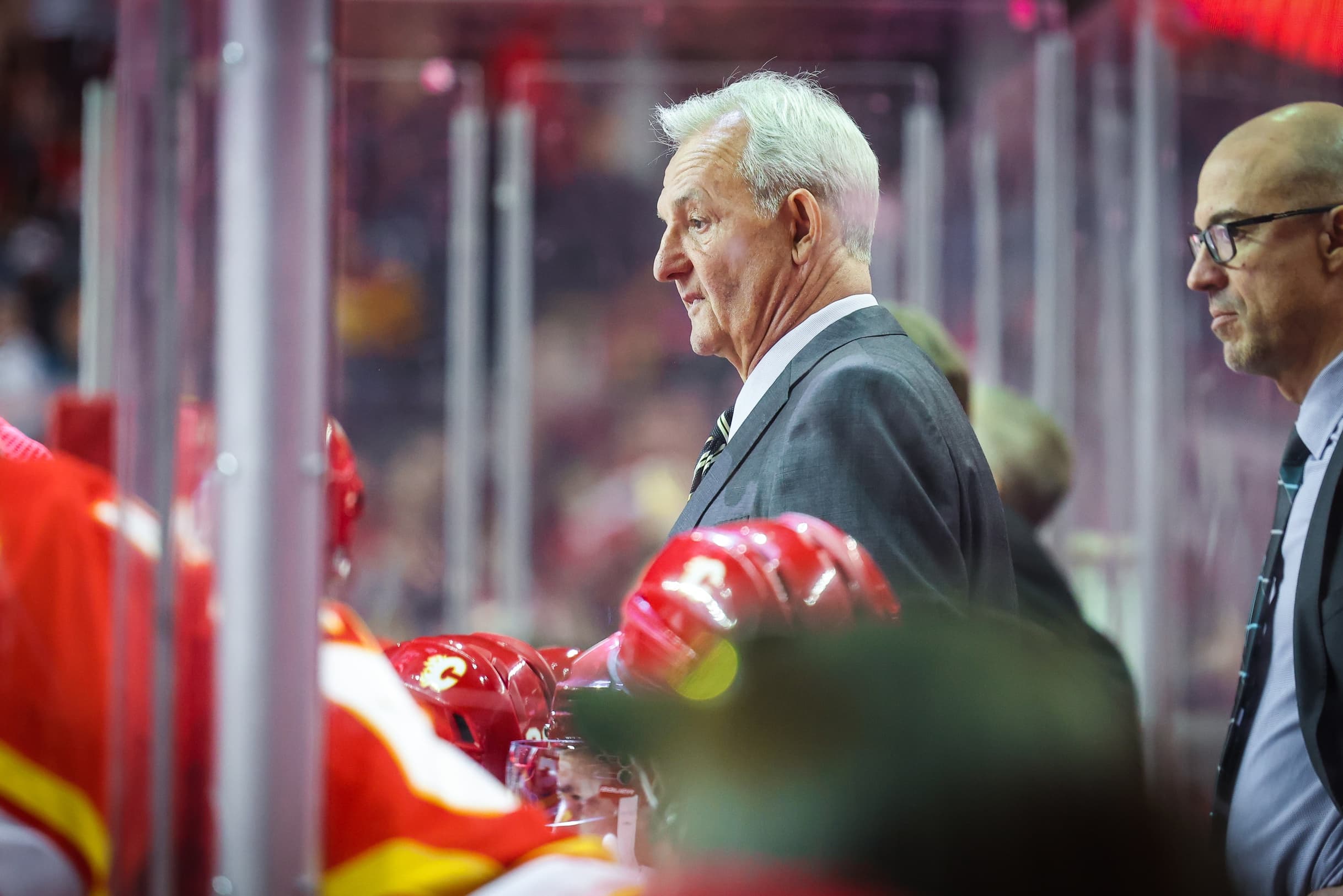
Photo credit: Sergei Belski-USA TODAY Sports


It’s safe to say that Darryl Sutter has seen and done a lot around hockey during his life.
A product of Viking, Alberta, Darryl was one of seven sons born to Louis and Grace Sutter and raised on their farm. Darryl and five of his six brothers – Brent, Duane, Ron, Rich and Brian – all went on to play professional hockey in the National Hockey League. While four of his brothers had stints with the Calgary Flames organization, Darryl definitely had the largest impact on the franchise, serving as general manager from 2003 to 2010, and as head coach for two stints (2002-06 and 2021-23), including guiding the Flames to the seventh game of the 2004 Stanley Cup Final.
On Tuesday, Sutter’s new book, written with Justin Bourne, The Code of the West: Lessons From the Ranch and the Rink, was released. Just prior to the start of the 2026-27 season, we caught up with Sutter to discuss the book, his career, and a lot more.
Questions and answers have been lightly edited for clarity.
DFO: I’m curious about the book. When I heard your book was coming out, my first thought was, ‘How did they get Darryl to do a book?’ How did you become involved in this?
DS: I think the publishers from Toronto contacted me probably a year and a half ago, just seeing if I was interested in doing something with them, and it just kind of started from there. It’s not easy to do. Like you think my brothers and I have done… in the ’80s we did, it was called the Six Shooters when we were all playing and that was sort of easy to do because the writer that helped us was a guy I knew out of Chicago, he was a sports columnist [Editor’s Note: Dean Spiros] and so it was basically just a hockey story. But this was one, it’s hard to explain, but I think everything going on with the ranch life and rural life and all that the stories that are out there, meaning like Yellowstone and all those types of things. They wanted to put something together, book-wise, that wasn’t just about hockey, it was sort of about the life thing. And so it was interesting to do, and it took a long time. It took almost nine months to complete it all. And then there’s so much editing. And then they wanted me to do the audio part of it, the audio read part of it. So that took another month, too, because, again, there’s a lot of editing and things that go into that. So, you know what, it was interesting. I think I learned a lot. And it’s interesting even for me just to read it because, you know, there’s a lot involved in it. It’s not just, as I said, it’s not just a hockey story. sort of the life story and then and then the lessons in it and the rules that, I guess, the rules that I’ve lived by, things like that so, you know what, it’s interesting.
Were you familiar with Justin Bourne before you started working with him? Because i know he wrote a book sort of about his life and his background as well.
Yeah, you know what, Ryan? Connection there would have been, so you’re given a list, of writers or guys that you’d be comfortable with to help you or to, you know, to go through it with you. And Justin jumped out for two reasons. First off, he’s from, he’s from out West, which is a big part of what the book’s about, quite honest. And his dad played with brothers Duane and Brent on those Stanley Cup teams with the Islanders. And then Justin’s wife is Clark Gillies’ daughter, who’s also from out west here. So, you know, there was a connection there anyway. So it worked really good. He stayed at the farm off and on. And we did a lot, obviously, either phone, email, texting, you know, secondhand through other people, things like that. But it was awesome to work with them because it was almost transparent. We almost knew each other what we should say or what we did say.
I’m curious for you personally because I know obviously all the brothers in your family got into hockey. Six of you played in the NHL. And I was always kind of amazed at how many of you brothers went into coaching when you finished up as well. When you couldn’t play anymore, what made you want to pursue coaching?
I think, you know, I’d be personally, Ryan, I was a young father. We had two children, and then the salaries were not, obviously not what they are now. And I was injured, retired at 28, what was it, 28 or 29. And you couldn’t just come back to the farm with those young kids and make a living. So I was so fortunate the Wirtz family in Chicago gave me the opportunity to stay in it as assistant coach and then coach the minors and then to come back and coach the Blackhawks. So, you know, that wasn’t something that, quite honest at the time, it certainly wasn’t something that I aspired to do at all. It was more like, hey, you know what, I’ve got a family to take care of. And then it just went from there.
Was there a point where you found yourself really enjoying it?
Yeah, you know what, my first year after retirement, I think when you have to, in our retirement, basically can’t play anymore. That was for sure my toughest year of all the 45 years in the NHL. That was the toughest year because you still want to play, but you’re an assistant coach. You’re working with your buddies, but you can’t hang out with them. You know, that sort of thing. So that was the hardest year for me. The best thing for me was going to, for sure, was going to coach the farm team for the two years and then come back to Chicago. So that’s when I really started to enjoy it, was riding the bus and working with those young guys. And obviously winning, you know, we won a championship the second year, so that always makes it easier.
When you were starting out, was there any coaches that you sort of looked up to or admired or tried to do things the way that they did it?
Yeah, you know, I was really lucky, Ryan. Chicago the last year, or maybe even two years I was there, and then injured players could be on the bench. And Bob Pulford and Roger Nielsen, who were both basically opposite ends of the spectrum in terms of coaches, Pully was the gruff old guy and the Stanley Cup player and all those things with the Leafs, and then Roger was the X and Os analytical, trained practice, all those things. So those two guys obviously had a big impact on me as a, you know, really as a first year, even though I was injured, as almost like an assistant coach. Those guys impacted me a lot, but the guys, once I became a head coach in the NHL, there’s no question, Al Arbour, Glen Sather, and Scotty Bowman were the three guys that I really, really looked up to.
You’ve been in hockey for so long, you had such a fantastic career as a coach. How do you stay motivated? Because I think in any line of work staying motivated, staying hungry can be tough for anybody.
Yeah, I think the motivation became very, very clear. Like, when we won the championship in the old International League [Editor’s Note: Sutter coached Indianapolis to a Turner Cup in the IHL in 1989-90], that became like the, that’s all you want to do is win a championship. And then lose, like we lost the Stanley Cup Finals to Pittsburgh in Chicago [Editor’s Note: In 1992]. And then losing in ’04, the finals in Calgary. So one was a four-game series, one was a seven-game series. That was all that motivated me. I wanted to coach the Stanley Cup team. And I recognized from going, you recognize when you go to the finals or go to conference finals, what it takes more and more. You have to do it to recognize and understand it. And then to be able to sustain and stay motivated, well, that’s what motivated me. And then even going to Los Angeles, I went because I believed they had the personnel to win a championship. And they were fortunate to win two and could have won three. Even when I came back to Calgary, I believe that team was close. We got beaten at whatever it was. The third year it was, we had [111] points to lose the second round. You’re so close to winning a championship there too. That’s all that motivated me, was winning a championship.
For you, what’s it like having your son become a coach? [Darryl’s son, Brett, is currently head coach of the Calgary Wranglers, the Flames’ farm team.] Did you sort of see him going into coaching? What did you think that he would be doing after he finished up?
You know, you never know, Ryan, about that. You hear the word ‘career coaches,’ things like that. Well, I think he was probably similar to me in the sense that he really understands the game good. He’s an Xs and Os guy. He really gets the game. He’s going to really work at it and be dedicated and put everything into it and then care about players. Because when you coach the farm team, especially when you’re with a lot of prospects, you’re developing players first, and you have to have a winning attitude and a real workman-like attitude. And he’s got that. I mean, the advantage that somebody like Brett has, you know, he grew up in a dressing room. You say what you want. Like, you see a lot of kids of, sons of former players that are players now that are going to coaching, staying in the game, that sort of thing. And that’s a big advantage growing up because it’s like an education from the time you’re a little boy. So, he’ll be a really good head coach as he moves forward.
Do you give him advice? Does he ask you for advice? I’m just curious because going into the family business I’d be like ‘Do I want to offer him advice?’ How do you approach it as both a dad and a guy with a pretty good coaching resume?
You know I don’t talk to him about hockey very much you may have a question once in a while where you’ll call more on some sort of a strategy or system or an idea type thing just bounce it off you but for firm advice or anything like that, zero because I think the staffs now are so good. I enjoy just talking. We’ll go this weekend and we’ll watch the two games against Abbotsford [Editor’s Note: We chatted with Darryl before the Wranglers’ opening weekend.] and enjoy watching them, see how the team plays, and maybe I’ll say something about a player or something like that or something they’re doing or ask what they’re doing in that situation. But in terms of real advice, I don’t think so. I think, you know, you’ve got to blaze your own trail. It doesn’t matter. I mean, if you try and emulate somebody else or, you know, not be yourself, I think that gets picked up pretty easily in the locker room.
The Code of the West: Lessons from the Ranch and the Rink, by Darryl Sutter with Justin Bourne, is now available everywhere you can buy books.
This article is presented by Leasebusters

LeaseBusters is Canada’s premier lease takeover marketplace, helping drivers get out of their current vehicle leases without costly penalties or negative equity. Instead of paying thousands to break a lease, sellers connect with qualified buyers ready to take it over—saving money and avoiding financial stress. Buyers benefit from shorter-term commitments and often better monthly payments, while dealerships retain a replacement customer and leasing companies keep contracts active. It’s a smarter, more efficient solution for everyone involved. Four parties, four wins—only with LeaseBusters. For more information, check out www.LeaseBusters.com


Breaking News
- Darryl Sutter reflects on his career, his son becoming a coach, and The Code of The West
- Beyond the Boxscore: Flames give start to finish quality performance in first victory of season
- Series preview: Wranglers kick off six game road trip with stop in San Jose
- Instant Reaction: Flames finally get two points after rematch with the Ducks
- NHL Notebook: Penguins and Sabres make small trade

Calgary FlamesTeam Cap Summary

Cap Summary
2026-27
2027-28
Projected Cap Hit
$89,682,143
$69,841,666
Projected Cap Space
$14,317,857
$43,658,334
Current Cap Space
$15,431,468
$43,658,334
Active Players
23/23
16/23
Draft Picks
Round
'27
'28
1
1
1
2
2
2
3
2
1