
FlamesNation has no direct affiliation to the Calgary Flames, Calgary Sports and Entertainment, NHL, or NHLPA
Flashback Friday: Looking at the three playoff series between the Flames and Sharks
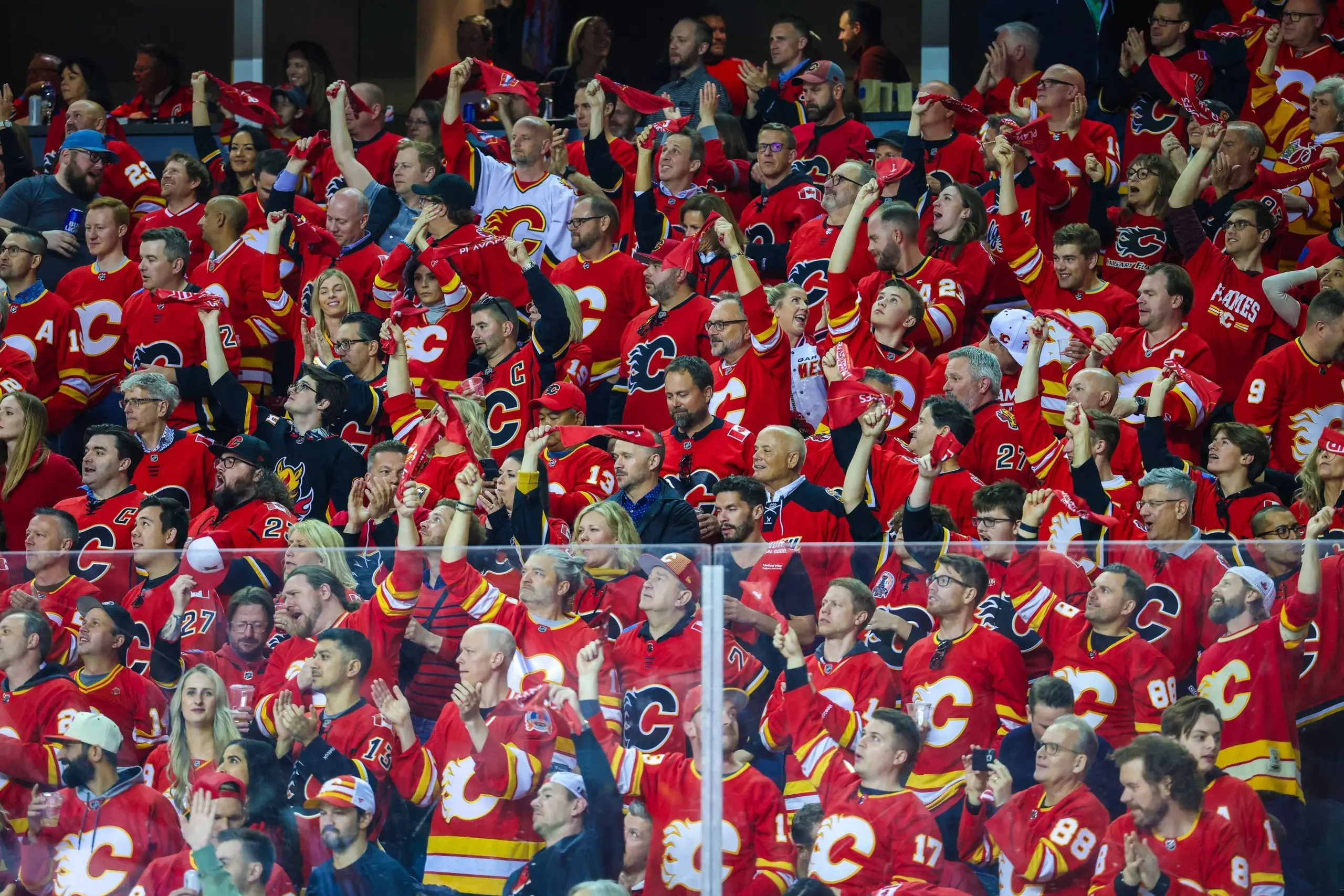
Photo credit: Sergei Belski-USA TODAY Sports

Jan 30, 2026, 16:00 ESTUpdated: Jan 30, 2026, 14:47 EST


On Saturday, the Calgary Flames will play the San Jose Sharks for the third time this season.
Earlier this season, we looked at the Miikka Kiprusoff trade in that edition of Throwback Thursday. Although Saturday will mark the one year anniversary of the two Andrei Kuzmenko trades the Flames made, as well as the Dion Phaneuf trade, we’ll be shifting away from trades in this edition of Flashback Friday.
It’s becoming increasingly clear that the Flames will miss the playoffs and will need to rebuild, even if they don’t really want to. That’s exactly what the Sharks did after falling in the Western Conference Finals back in 2019.
Now, that rebuild is coming to fruition for the Sharks, as they are in a three-way tie for the final wild card. There’s still a few seasons before even becoming close to a contender, but the emergence of Macklin Celebrini has been huge, and they’ll be a strong team for years to come.
If the Flames decide to rebuild before the Mar. 6 trade deadline, moving on from players like Blake Coleman, Nazem Kadri, and potentially even MacKenzie Weegar, there’s a chance that the Sharks and Flames windows of contention will overlap further on down the line.
It’s been a while, but the two teams have actually met in the playoff before, three times in fact. In this edition of Flashback Friday, we’ll look at the three series the Sharks and Flames have played.
1995
Although the Flames still had remnants from the 1989 Stanley Cup winning team, and were regularly making the playoffs, it was clear their window of contention had closed in 1994. In four of the last five seasons, the Flames fell in the first round, and missed the playoffs outright in 1991-92.
That 1991-92 season served as the first in the league for the Sharks. As per expected, the expansion franchise didn’t have much success, winning just 17 games in a season in which they went 17-58-5. Somehow, their second season was even worse, going 11-71-2, tied for the four-fewest wins in a season in National Hockey League history.
The 1994 playoffs was one of upsets. In the Eastern Conference, the seventh-seeded Washington Capitals defeated the Pittsburgh Penguins. The second-seeded Flames fell in seven games to the seventh-seed Canucks, while the eighth-seeded Sharks knocked off the Presidents’ Trophy-winning Detroit Red Wings.
In the second round, the Sharks nearly upset the Toronto Maple Leafs, who were in the Western Conference at the time, ultimately falling in seven games. In the lockout impacted season, the Flames finished with 55 points, winning their division, while the Sharks were once again the seventh-seed, setting up the two team’s first playoff matchup.
In Game 1, the Flames struck first early in the first period, but the Sharks scored four unanswered to take a 4-1 lead. Late in the second, the Flames made it 4-2, but it was swiftly answered with just 18 seconds left in the middle frame. The Flames scored twice late in third period, including a goal with six seconds left, but lost the series opener 5-4.
The second game also saw the Flames fall 5-4, but in overtime this time. They blew a 2-0 lead before the Sharks fired off three unanswered. In the third, the Flames tied it, the Sharks retook their lead, then Robert Reichel scored with 47 seconds left to send the game to overtime. On a power play, Ulf Dahlén scored the game winning goal.
Heading to San Jose, the Sharks had a commanding 2-0 series lead, but the Flames thrashed the Sharks 9-2 in a must-win game, with Mike Sullivan scoring a hat trick. Looking to avoid going down 3-1 in the series, the Flames jumped out to a 3-0 lead in Game 4 and ultimately won 6-4 to make it a best-of-three series.
With the series returning to Alberta, the Flames put up a goose egg on the Sharks, as Theo Fleury scored twice in a 5-0 victory to push the Sharks to the brink. Quick spoiler alert, this was the Flames’ final playoff victory for nearly a decade. The series shifted back to San Jose for Game 6 in a must-win game for the Sharks. They did just that thanks to a three-goal second period in a 5-3 win, setting up a winner-take-all Game 7.
That game took place on May 19th, 1995 in Calgary. The Sharks opened the scoring in the first period, and had a 2-0 lead until late in the second period before Paul Kruse scored to cut the lead in half. It took 19 seconds into the third for the Sharks to restore their two-goal lead, but the Flames scored three times, while the Sharks scored twice to set up overtime.
After a scoreless first overtime period, it took Ray Whitney just 114 seconds to end the Flames’ season with a close-range redirection in front of Trevor Kidd. This season may have been the beginning of the dead-puck era, but the Flames’ 35 goals is tied for the second-most in a single series, and the most for a losing team in a series. The two teams combined for 61 goals, which is also up there for the most goals in a playoff series.
2004
Although the Flames’ final playoff win was in the 1995 playoffs, they did manage to make the 1996 postseason. Unfortunately, they didn’t do a whole lot in their series against the Chicago Blackhawks, as they lost all four games. The Flames then missed the playoffs for the next seven seasons.
Early into the 2003-04 season, the 6-8-1 Flames traded a pick to land Sharks’ netminder Miikka Kiprusoff. Sitting in second last in the Western Conference at that point, the Flames went 36-22-6 for the remainder of the season, with Kiprusoff finishing with a 24-10-4 record in the 38 games he played.
The Sharks finished second in the conference, while the Flames sat sixth. However, the beat the third-seeded Canucks in seven games, the the first-seeded Red Wings in the second round, setting up the second showdown between the Flames and Sharks in the post-season.
With the series beginning in California, the Flames opened up with a 4-3 overtime win. In the first, they got goals from Krzysztof Oliwa and Craig Conroy, but the Sharks followed suit with two goals in the second period. In the third, the two teams exchanged goals to set up overtime, with defence Steve Montador finding the game-winner late in the first overtime period.
Just like the 1995 series, the away team won the first two games to begin the series. Marcus Nilson’s goal 20 seconds in set the tone, with Shean Donovan scoring midway through the first. The Sharks cut the lead five minutes into the second period, but two third period goals gave the Flames a 4-1 victory and 2-0 series lead heading to Alberta.
Also like the 1995 series, the higher-seeded team won two-must win games on the road. In Game 3, the Sharks blanked the Flames at the Saddle Dome, followed by a 4-2 win in Game 4 thanks to four second period goals, making this series a best-of-three.
With the series back in San Jose, Jarome Iginla scored a short-handed goal six and a half minutes into the first period, with Nilson scoring about two minutes later. Iginla’s goal was all they needed, as Conroy added a third in the second period for the 3-0 victory and a chance to win the series in Calgary.
Unlike the 1995 series, the Flames got the job done in Game 6. Late in the first, Iginla scored a power play goal, and Martin Gélinas scored with seven minutes left in the second period. The Sharks cut the lead in half with four minutes left in the second, but the Flames were able to survive, as Robyn Regehr scored an empty netter with a second left in the game. Shoutout to the old CBC scorebug, that one ruled.
It was the third consecutive series that Gélinas scored the game-winner, as he scored the overtime winner in Game 7 in the first round, as well as the overtime winner in Game 6 in the second round. In Game 6 of the Stanley Cup Final, Gélinas shot crossed the goal line in what should’ve been the game-winning goal that brought the Stanley Cup back to Canada, but it was ruled no-goal and the Lightning won in seven.
2008
The Flames were still a competitive team following the Game 7 loss in the Finals. After the lockout took out all of the 2004-05 season, the Flames played a highly entertaining seven game series against the Ducks in the first round.
Facing the first-seeded Red Wings in the first round of the 2007 post-season, the Flames put up a competitive fight, losing in Game 6 thanks to a double overtime goal. The Red Wings defeated the Sharks in the second round.
The Sharks had a strong 2007-08 season finishing second in the Western Conference with 108 points, while the Flames finished the season with 94 points, setting up the most-recent playoff matchup between the two teams.
In Game 1, the Flames got out to a 1-0 lead thanks to a goal from Stephan Yelle three minutes into the period. Less than three minutes later, Dion Phaneuf scored a power play goal to give them a 2-0 lead. Ryane Clowe scored to cut the Flames’ lead in half, but Yelle scored his second of the game late in the second period. That turned out to be the game-winner, as Clowe’s late goal in the third wasn’t enough.
Game 2 belonged to the Sharks, as they won 2-0. Joe Pavelski scored five minutes into the second, and Torrey Mitchell added a late power play goal in the middle frame. If not for Kiprusoff, this game could’ve been out of hand as the Sharks out-shot the Flames 43 to 21.
Kiprusoff had a total opposite game in Game 3, allowing three goals on the first five shots he faced, giving the Sharks a 3-0 lead before the game was even four minutes in. After being pulled, Iginla scored a power play goal to make it 3-1 heading into the second. Midway through the second, Daymond Langkow scored to bring the Flames within one, and Phaneuf tied the game up early in the third. With under four minutes to play, Owen Nolan scored the game-winning goal to put the Flames up 2-1 in the series.
With a chance to push the Sharks to the brink, the Flames failed to win Game 4. Iginla opened the scoring in the first period, before the Sharks scored midway through the second. Late in the second, Paneuf scored to make it 2-1. With five minutes left in the game, Jonathan Cheechoo tied the game, and Joe Thornton scored with 10 seconds left in the game, as the Flames totaled just 10 shots.
In Game 5, Iginla opened the scoring four minutes into the second period, but the Sharks responded with four unanswered goals to take a 4-1 lead. Midway through the third, Langkow scored to make it 4-2, then David Moss scored to make it 4-3, but the Flames were unable to find the game-tying goal to push them to the brink of elimination.
Thankfully, the Flames were able to win at the Saddledome in Game 6. Nolan scored midway through the first, Langkow scored in the final minute of the second, and Kiprusoff stopped all 21 shots he faced in a 2-0 victory. That set up another winner-take-all Game 7.
The two teams exchanged power play goals in the first period, Thornton opened the scoring 11 minutes into the game, and Iginla tied it less than two minutes later. Things seemed to be going well, as Nolan broke the deadlock three and a half minutes into the second period, but the Sharks scored four unanswered goals before the end of 40 minutes. Wayne Primeau scored five minutes into the third, but the Flames fell 5-3.
All three of the series between the Sharks and Flames have been entertaining, and hopefully, we get more of these games in the future.
Ryley Delaney is a Nation Network writer for FlamesNation, Oilersnation, and Blue Jays Nation. She can be followed on Twitter @Ryley__Delaney.
Sponsored by bet365:


Recent articles from Cynthia Ryley Delaney
Breaking News
- Beyond the Boxscore: Flames give fans something to cheer about despite 4-2 loss to the Ducks
- Flames still in search of their first win despite a good showing against Anaheim
- Instant Reaction: Flames battle hard, but fall short against Ducks
- Friedman: Canucks ‘considering’ move for Flames’ Connor Zary
- Flames roster news: Sam Honzek to miss Saturday’s game due to unspecified injury

Calgary FlamesTeam Cap Summary

Cap Summary
2026-27
2027-28
Projected Cap Hit
$89,682,143
$69,841,666
Projected Cap Space
$14,317,857
$43,658,334
Current Cap Space
$15,178,493
$43,658,334
Active Players
23/23
16/23
Draft Picks
Round
'27
'28
1
1
1
2
2
2
3
2
1