FlamesNation has no direct affiliation to the Calgary Flames, Calgary Sports and Entertainment, NHL, or NHLPA
How the Calgary Flames sharing an AHL affiliate led to Brennan Evans making franchise history
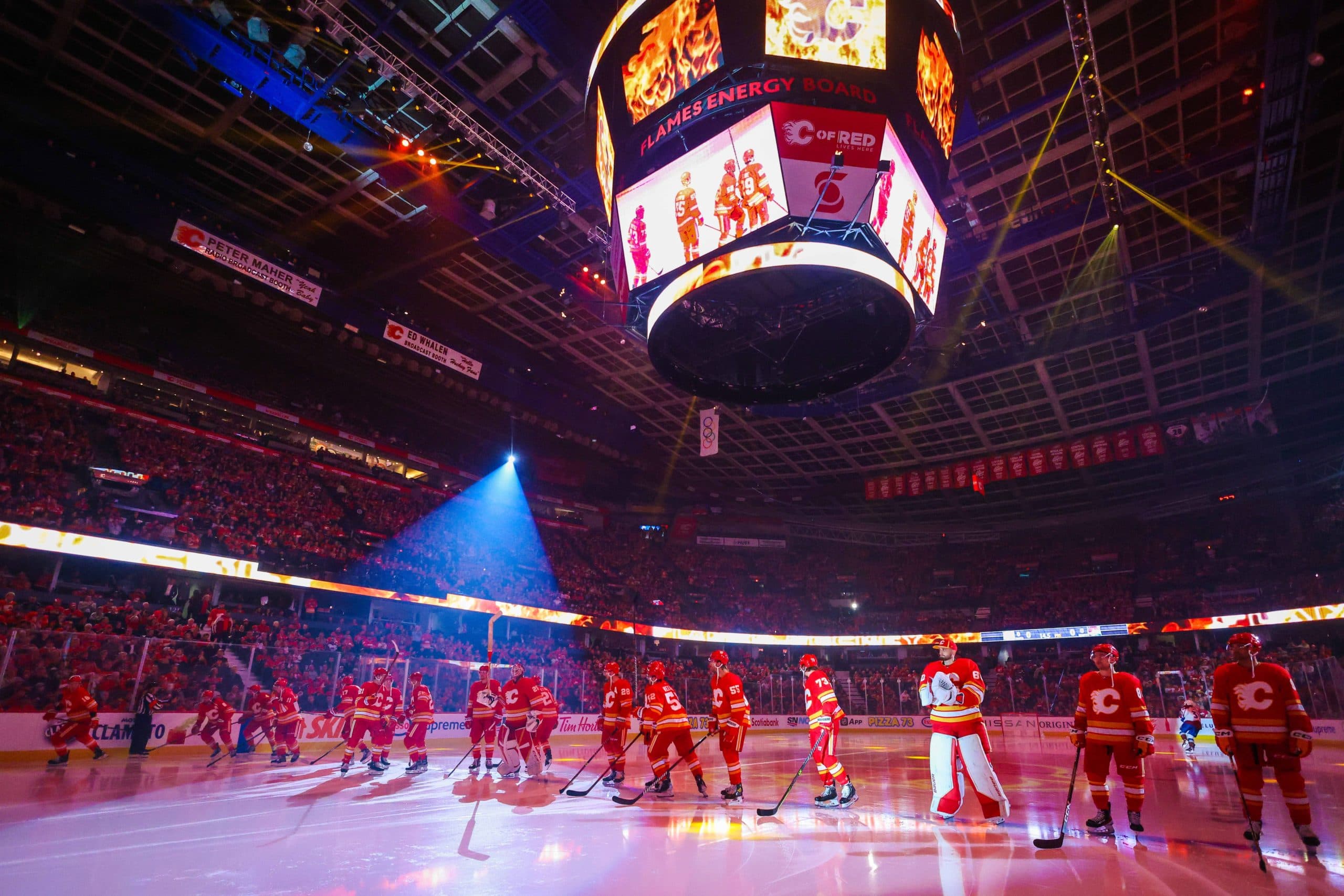
Photo credit: Sergei Belski-USA TODAY Sports


This article is brought to you by bet365.
Here’s a little secret, friends: most minor league teams don’t make very much money. Running an entire farm team to have backups for your National Hockey League club is pricey, even moreso when they play in a far-flung locale, but the benefit is having plenty of additional players at your disposal that know how to play your system.
Until 2002-03, the Calgary Flames owned and operated their American Hockey League affiliate, the Saint John Flames. Prior to the 2003-04 season, the Flames opted to discontinue their AHL franchise and share a farm team – the Lowell Lock Monsters – with the Carolina Hurricanes. The Flames were no longer on the hook for the costs of a full farm team, but they also had reduced backup options for their NHL club – they were allocated a goaltender and eight skaters on the roster – and the Lowell coaching staff were all employed by the Hurricanes.
You see, there are risks you assume when you no longer have your own farm club. And there’s no better encapsulation of that than one of the most unique players in Flames franchise history: blueliner Brennan Evans.
The Flames began the 2003-04 season with eight defencemen in the NHL, three defencemen in Lowell – Jesse Wallin, Roman Rozakov and Evans – and Deryk Engelland with the ECHL’s Las Vegas Wranglers. (Evans and Engelland were both first-year pros signed to three-way deals with different salaries at the NHL, AHL and ECHL levels.) Wallin suffered a concussion in Lowell’s first game and Rozakov headed back to Russia after two games, with Mike Commodore being sent down from the NHL soon after, leaving the Flames with just Evans and Commodore as AHL reinforcements for much of the season.
With head coach and general manager Darryl Sutter dissatisfied with his blueline in early February, he called up Commodore to shake them out of their mid-year lull. Commodore was briefly back in the AHL for the NHL’s All-Star Break and missed a few weeks with a shoulder injury upon his return to the NHL, but he was with the big club for the rest of the season.
The Flames began the playoffs with six healthy defencemen, plus Commodore and Steve Montador as healthy extras. When the AHL season ended, Engelland joined Las Vegas for the ECHL playoffs (along with a couple Lowell players under Flames contracts), goalie Brent Krahn joined the Flames as their third goalie after playing out a loan in San Antonio, and the remainder of the Flames’ AHLers were sent home.
“I was in Lowell the whole year,” said Evans, noting that his goal was to stick in the AHL the whole year as a first-year pro. “I was only in my first year, in and out of the lineup and grinding it out. Not really any prospects of getting called up. At the end of the year, do the kind of post-season things that young guys do, and go out and have fun. I actually shipped my equipment home from Lowell to Edmonton.”
Toni Lydman was injured in Game 3, and Commodore jumped into action. Denis Gauthier was injured in Game 6, and Montador joined the lineup for Game 7, leaving the Flames with no remaining healthy extra bodies.
“Here’s how hurt we were,” said Commodore. “I was on the power play against Vancouver, and I do not remember that at all.”
“I was in my grandparents’ house in Saskatoon watching Game 6 against Vancouver,” said Evans. “And like another defenceman got hurt, and the phone rings.”
When the Flames advanced past the first round, they summoned Evans and forward Martin Sonnenberg to join Krahn as the team’s black aces – extra bodies to fill in during playoff practices. Evans’ usual equipment was in transit to Edmonton, so he had to piece together a set of gear from his garage before heading to Calgary to join the Flames for practice. (The Wranglers were eliminated from the ECHL playoffs around this time, but Engelland wasn’t summoned despite being on an NHL contract.) With Commodore and Montador already pressed into action, the Flames were one injury away from an AHL rookie dressing in a playoff game.
Then Rhett Warrener took a stick in the eye from Steve Yzerman in Game 2 in Detroit and was suddenly unavailable for Game 3.
“Rhettro got stuck in the eye,” said Evans. “He went to the doctor after pre-game skate and I was in my bed at the International. And I forget who called me, but one of the Flames brass called and said ‘Hey, Rhettro can’t go, so you’re playing.'”
Evans’ played one shift with Mike Commodore in the first period of Game 3 and was credited with 32 seconds of ice time, but was a spectator for the remainder of his NHL debut. The Flames won 3-2.
“There was some weird play in the neutral zone where Yzerman got the puck and I kind of stepped up on him,” said Evans. “So I had one shift in that game, and in that shift I have this great picture of me kind of stepping up and having kind of a face-wash with Stevie Y… And then I got the best seat in the house, and I didn’t play the rest of the game. I just sat there and watched. It was awesome.”
Evans’ ice time grew significantly in Game 4, where he played 5:11 over eight shifts. The Flames lost 4-2. Warrener returned to action for Game 5 and Evans’ appearances in the playoffs were over. He remained with the Flames, skating with Krahn, Martin Sonnenberg and Lynn Loyns as extras for the remainder of the post-season.
A lockout wiped out the 2004-05 NHL season, squashing Evans’ hopes of following up on his playoff cup of coffee with the Flames. (The Flames revived their AHL farm team following the lockout year.) Evans left the Flames organization as a free agent after spending the 2004-05 campaign in Lowell, and bounced around a bit looking for another NHL opportunity – he spent time in the minor league systems of the Ottawa Senators, San Jose Sharks, Anaheim Ducks and St. Louis Blues.
Evans was unable to find his way back to the NHL, but he built a reputation for himself as a really effective, reliable minor league blueliner. Despite not getting another big league chance, his career had a strong second act as a veteran leader for several AHL teams where he wore a letter and served as a mentor to up-and-coming talents.
“There’s the old joke, you kind of go from prospect to suspect,” said Evans. “So now, I kind of have to make a decision: am I happy to assume the role of mentor, to be a guy that can come in and play minutes and help the young guys along? Or do I want to go to Europe? Or do I want to quit or whatever?”
Including his 2003-04 rookie year, Evans ended up playing 870 AHL games across 13 seasons. He won the Calder Cup in 2013 with the Grand Rapids Griffins, Detroit’s farm team.
“Looking back on it now, I feel like I made the right decision, just played for as long as I could,” said Evans.
Evans’ playing career ended with three seasons in senior league hockey with the Lacombe Generals – where he won three league championships and an Allan Cup. He’s remained involved in the game since retiring as a player, working as a skills and development coach, and joined the Okanagan Hockey Academy in Edmonton as a coach in 2023.
In the 51 seasons of Flames franchise history dating back to Atlanta, Evans remains the only player to only play in the playoffs.


Breaking News
- Flames roster news: Mikael Backlund and Jonathan Huberdeau skated with team on Saturday
- Flames Game Day 10: A visit from the Red Wings (8pm MT, SNW)
- The Flames’ 2004 green hard hat returns as a fan giveaway on Saturday
- Series Preview: Wranglers wrap up road trip in second series against Canucks
- Notes from last game: Devin Cooley plays out of his mind again in Flames’ 2-1 victory over Wild

Calgary FlamesTeam Cap Summary

Cap Summary
2026-27
2027-28
Projected Cap Hit
$90,440,132
$69,841,666
Projected Cap Space
$13,559,868
$43,658,334
Current Cap Space
$15,474,202
$43,658,334
Active Players
23/23
16/23
Draft Picks
Round
'27
'28
1
1
1
2
2
2
3
2
1