
FlamesNation has no direct affiliation to the Calgary Flames, Calgary Sports and Entertainment, NHL, or NHLPA
The NHL signing rights of college-bound major junior players are surprisingly straightforward
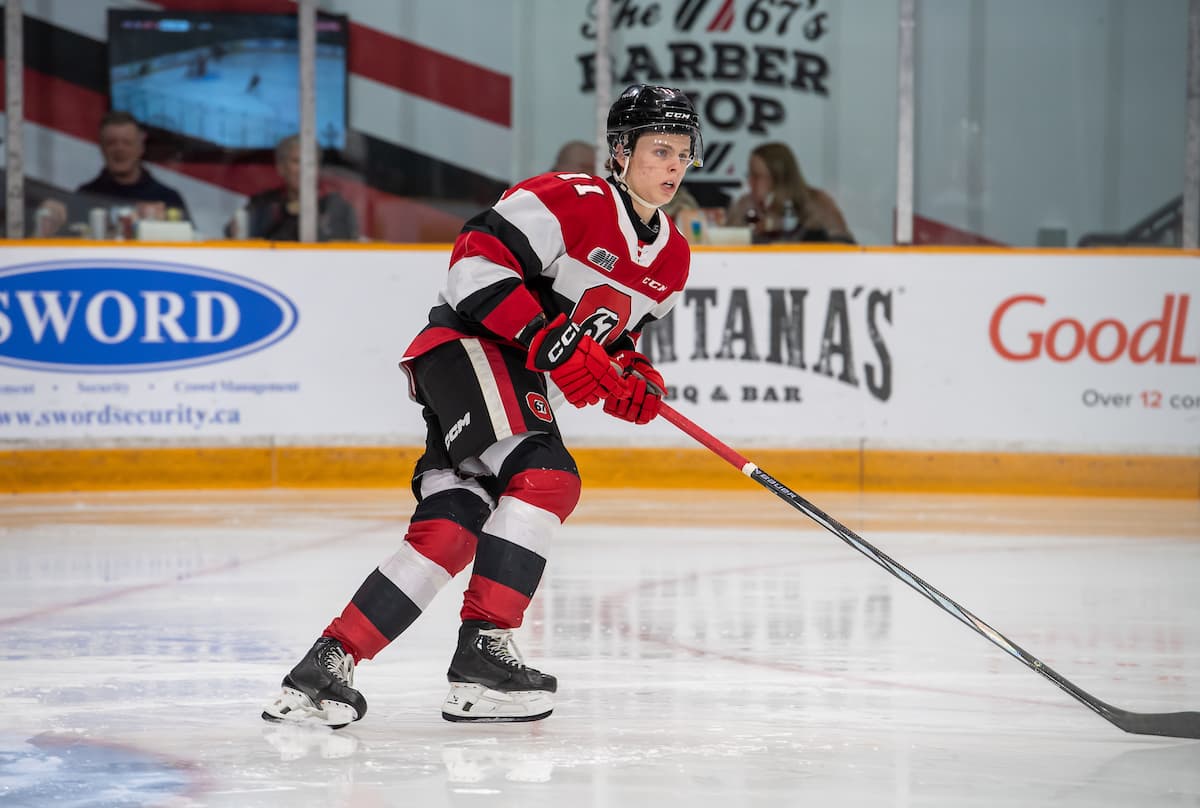
Photo credit: Robert Lefebvre / OHL Images


It’s a brave new world when it comes to options for young hockey players outside of the professional ranks.
Earlier this season, the NCAA changed its rules regarding player eligibility for men’s hockey. It used to be that if you played Canadian major junior, it counted as being a pro for the sake of your NCAA eligibility and so you had to choose between playing in the CHL or the NCAA.
Well, that’s done and dusted. If you’re a CHL player, unless you sign an actual pro contract you’re still eligible to play in the NCAA. (Sorry, Zayne Parekh and Matvei Gridin, because you signed your entry level NHL deals, you can’t play college hockey.)
But quite a few CHL players have committed to college since the NCAA’s rule change. Reportedly among them is Calgary Flames draft choice Eric Jamieson, who’s said to be headed to the University of Denver. And a rumour that simply will not go away – to the point where it was mentioned by Postmedia’s Don Brennan in a column following the OHL’s trade deadline – is Henry Mews going to to the NCAA next season.
Arguably the most common prospect-related question we’ve received this season has been some version of “Hey, so how does the new NCAA situation impact signing rights for drafted NHL prospects?”
We dug into Article 8 of the Collective Bargaining Agreement, which explains the various scenarios that govern how long NHL teams hold onto the rights for unsigned drafted prospects. And the collegiate piece of the puzzle seems to complicate things much less than we anticipated.
If you’re drafted out of the CHL, your NHL club holds your rights until the second June 1 after you’re drafted, as long as they provide you with an ELC offer before the first June 1. So, using Mews or Jamieson as an example, the Flames would have until June 1, 2026 to sign them if they remained in the CHL. (This is a common enough scenario that this is the default scenario under Article 8.6(a) in the CBA.)
Now, if a player is drafted at 18 or 19 as a college student, or becomes a college student before the first or second June 1 after being drafted, then their NHL club retains their rights until the Aug. 15 after their college class graduates – generally calculated as after four years of college. So if Mews or Jamieson went to college next season (2025-26), then the calculation for their rights would default to the Flames having them until Aug. 15, 2029. As of right now, the Flames hold the rights to 2023 draftee Aydar Suniev (a sophomore at UMass) through Aug. 15, 2027 and 2021 draftee Arsenii Sergeev (a junior at Penn State) through Aug. 15, 2026, assuming they both stay in college until graduation. (Suniev went straight into college after being drafted, while Sergeev spent a season in the USHL first.)
However, lots of drafted college players don’t stick around school for all four years. So if a player opts to leave college before graduating, then their NHL team retains their rights until the later of the fourth June 1 after their drafting or 30 days after the NHL’s Central Registry is told they’re leaving college. (And if they leave college after Jan. 1 and are in their fourth year of college, the rights expiry would shift to Aug. 15 like it would for a graduating college player.) Generally speaking, if a drafted prospect leaves school before their graduation… it’s because they’ve signed an NHL deal, so this isn’t a scenario that we see unfold in practice very often.
So what would happen if a player drafted at 18 or 19 plays two seasons in the CHL after being selected – they would have been offered an ELC after their first season – but opts to go to become a college student after two seasons rather than go pro? Based on some past precedents with players spending two seasons in USHL and then going to college, such as past Flames pick Mitchell Mattson, the NHL club would maintain those signing rights. (The CBA says that a player needs to “become a bona fide college student before the second June 1” in such a scenario, but seemingly committing to a school and registering is enough based on past situations with USHL players.)
We’ll be blunt: the CBA has some clunky writing in some of its articles, and so there’s some imprecise language that makes understanding some of the sections a bit of a hassle. But based on what’s in the current incarnation of the CBA, we don’t think they need to completely overhaul the sections discussing drafted player rights in light of the recent NCAA eligibility changes.
Sponsored by bet365:


Breaking News
- Flames roster news: Mikael Backlund and Jonathan Huberdeau skated with team on Saturday
- Flames Game Day 10: A visit from the Red Wings (8pm MT, SNW)
- The Flames’ 2004 green hard hat returns as a fan giveaway on Saturday
- Series Preview: Wranglers wrap up road trip in second series against Canucks
- Notes from last game: Devin Cooley plays out of his mind again in Flames’ 2-1 victory over Wild

Calgary FlamesTeam Cap Summary

Cap Summary
2026-27
2027-28
Projected Cap Hit
$90,440,132
$69,841,666
Projected Cap Space
$13,559,868
$43,658,334
Current Cap Space
$15,474,202
$43,658,334
Active Players
23/23
16/23
Draft Picks
Round
'27
'28
1
1
1
2
2
2
3
2
1