
FlamesNation has no direct affiliation to the Calgary Flames, Calgary Sports and Entertainment, NHL, or NHLPA
Who’s the Flames’ better option in net: David Rittich or Cam Talbot?
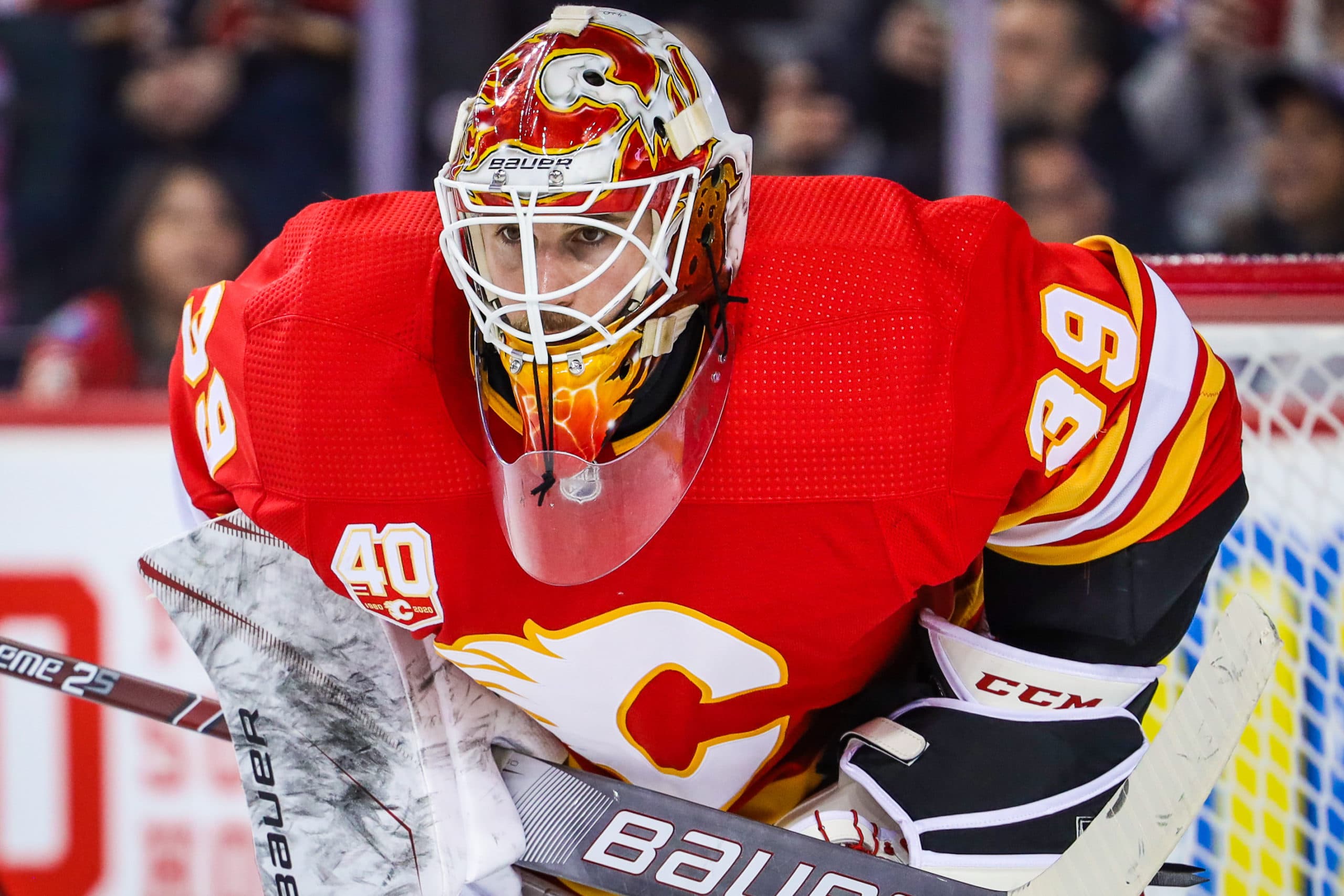
Photo credit: Sergei Belski-USA TODAY Sports


Ever since it became apparent that the National Hockey League might have a post-season, there has been one nagging question for Calgary Flames fans: who’s going to start in net? With the beginning of the 2020 Stanley Cup qualifying round just nine days away, we ask: who’s the Flames’ better option in net against Winnipeg: David Rittich or Cam Talbot?
All even strength shots
(All data cited here is via Natural Stat Trick.)
Because special teams are mostly systems and sweet, sweet chaos, even strength save percentage has become the general barometer for goaltender quality. League average save percentage for goaltenders at five on five was .919. Rittich was .916 and Talbot was .925.
So that’s easy, right? Ignoring all context – shot quality and the ebbs and flows of a season – Talbot’s the top dog.
Here’s each netminder’s rolling five game average for the season (Rittich in blue, Talbot in orange):
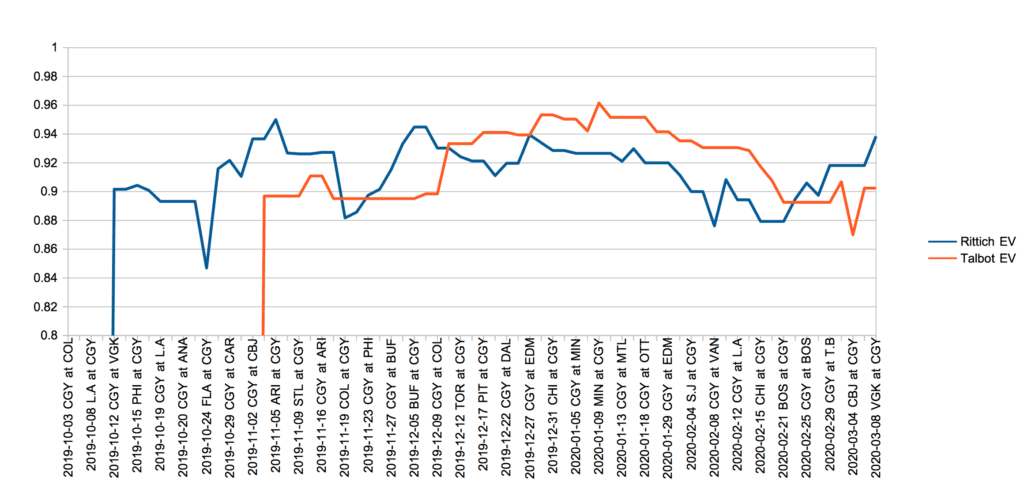
Once Talbot played enough games for this comparison to matter, he caught up quickly and surpassed Rittich for a big chunk of the season before dipping a bit near the end.
High danger shots
(High danger shots are all shots immediately in the net-front area, plus any shots from the larger “home plate” area in front of the net off the rush or off a rebound.)
Who’s better at making big saves? The league average was .824. “Big Save Dave” had a .836 save percentage. Talbot had a .806. If the game style is scrambly and chaotic, Rittch may be the man to call upon.
Same graph as before (rolling five game average), but just high danger shots:
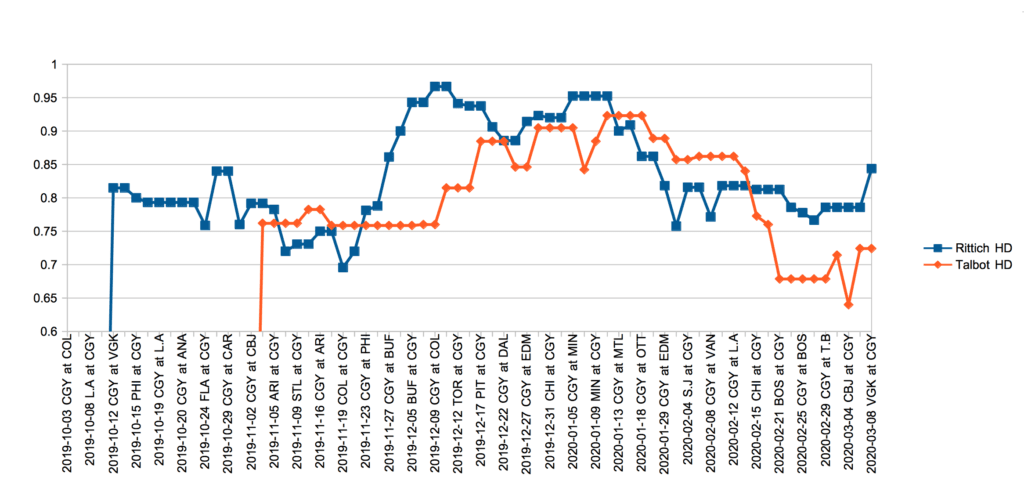
Aside from brief windows in the season, Rittich led wire to wire. And the gaps got pretty big at times between the two netminders. (As an aside: we don’t know when Rittich had his elbow injury or how serious it was, but look at how his rolling average dropped beginning in mid-January…)
Low danger shots
(Low danger shots are essentially any shots that aren’t from the main “home plate” area.)
We’ll get into this later, but here’s the thing: most shots in hockey games are low danger shots. If your team is any damn good at shot suppression, low danger shots will be the majority of shots your goaltender faces. And you don’t want your goalie to be Brian Elliott and giving up weak shots from the sides when the playoffs are on the line.
League average low danger save percentage was .971. Rittich was .971, Talbot was .975.
Same chart once more, but low danger:
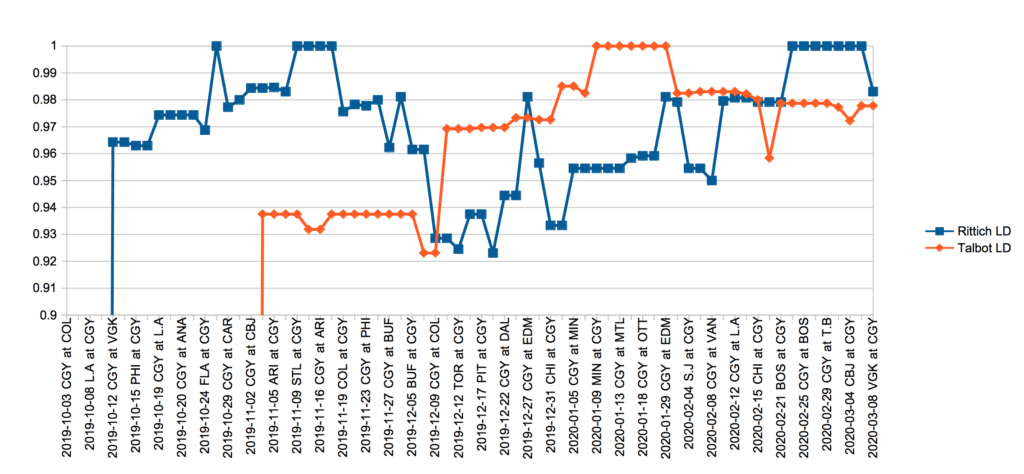
It’s not a big gap, obviously, but on the most common shots a goaltender will face in a game Talbot is the better goalie.
About the Jets
League-wide, high danger shots account for 26.0% of shots (low danger shots are 42.7%). For Winnipeg, only 21.3% of their shots are high danger shots. (In other words, they get lower quality shots on net compared to the league average.)
If you accept that swapping out Derek Forbort for Travis Hamonic is a defensively lateral move and won’t result in the Flames allowing appreciably more high danger shots than they did this season, then it may be more important to have the stronger low-danger goalie all other things being equal. That would be Talbot. If you think that summer playoffs will be utter chaos and will lend themselves to more high danger chances, maybe you want the guy that was great at stopping them, which would be Rittich.
Based on what the regular season told us about the Jets’ offensive tendencies and the Flames’ goaltenders, Talbot appears to be the better fit for the playoffs.


Breaking News
- Instant Reaction: Flames keep rolling, beat Red Wings on 2004 throwback night
- Flames roster news: Mikael Backlund and Jonathan Huberdeau skated with team on Saturday
- Flames Game Day 10: A visit from the Red Wings (8pm MT, SNW)
- The Flames’ 2004 green hard hat returns as a fan giveaway on Saturday
- Series Preview: Wranglers wrap up road trip in second series against Canucks

Calgary FlamesTeam Cap Summary

Cap Summary
2026-27
2027-28
Projected Cap Hit
$90,440,132
$69,841,666
Projected Cap Space
$13,559,868
$43,658,334
Current Cap Space
$15,565,766
$43,658,334
Active Players
23/23
16/23
Draft Picks
Round
'27
'28
1
1
1
2
2
2
3
2
1