
FlamesNation has no direct affiliation to the Calgary Flames, Calgary Sports and Entertainment, NHL, or NHLPA
Are the Flames better prepared to draft high than they were in 2014?
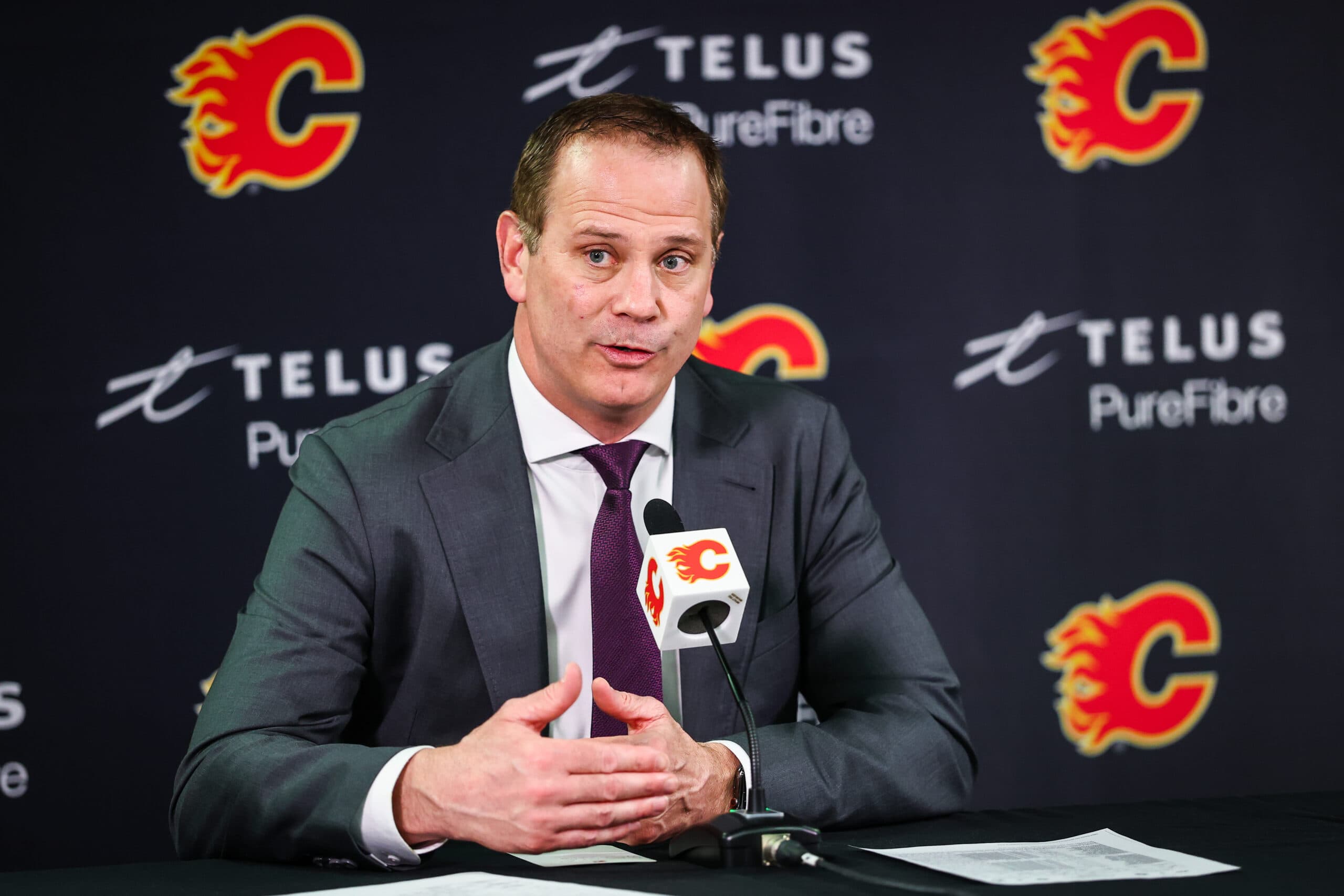
Photo credit: © Sergei Belski-Imagn Images

By Adrian Kiss
Jan 15, 2026, 18:00 EST


We’re at a difficult point when it comes to predicting how the rest of the Calgary Flames’ season will unfold, and it doesn’t rely entirely on their own performance. The NHL standings are tightly packed, with a small gap separating a wild-card spot from the bottom of the league. The Flames don’t need to play particularly well to remain in the playoff picture, while playing poorly doesn’t necessarily push them to the bottom if other teams struggle just as much.
What is clear right now is that the Flames are in a position where they could realistically end up with the highest draft pick in franchise history. It’s clear when looking at past Stanley Cup champions, it can be quite beneficial to have that high end talent found at the beginning of a draft.
Flames fans are all too familiar with “mushy middle” finishes, with the club’s top pick often falling in the 11-to-20 range. The Flames have selected in the top 10 just nine times in the organization’s 45-year history. Most recently, that came two years ago when they selected Zayne Parekh ninth overall.
The Flames have never owned a top-three pick. The highest selection in franchise history was fourth overall in the 2014 NHL Draft, when they selected Sam Bennett.
With the organization potentially lining up for a similarly high pick again, it’d be interesting to compare this current Flames team to the one that preceded the 2014 draft.
The 2013-14 Flames marked the beginning of a new era. It was the first season in more than a decade without Jarome Iginla or Miikka Kiprusoff. While the prospect pool was considered fairly deep at the time, the Flames were still in for a few difficult seasons as they waited for high-end talent to arrive. Sound familiar?
Offence
Offence was a struggle that season. The Flames scored just 202 goals, ranking 23rd in the league, with production driven largely by veteran players. Jiri Hudler led the team with 54 points, while Michael Cammalleri led the club with 26 goals. Rookie centre Sean Monahan scored 22 goals in a strong first season, while veteran Matt Stajan and young Mikael Backlund were also regular contributors.
On defence, newly named captain Mark Giordano led the blue line with 47 points, supported by T.J. Brodie and Kris Russell.
Looking at the present, the picture is similar. Veteran players are once again doing most of the heavy lifting. Nazem Kadri leads the Flames in scoring with 32 points, while Blake Coleman is the team’s leading goal scorer with a mediocre 13 goals.
Like Monahan in 2013-14, the Flames currently have just one young player producing offence at a consistent rate. Matthew Coronato is that one player and he currently has 12 goals and 25 points.
Both Flames teams also featured younger players with high expectations who either never reached, or have not yet reached, their full NHL potential. In 2013-14, that group included Joe Colborne, Paul Byron and Sven Baertschi. Today, comparable names might be Connor Zary, Morgan Frost or Sam Honzek. The difference now is that there is still time for this current group to make its mark.
This season, the Flames are tied for last in the league in goals scored and are on pace to set several franchise lows, including the fewest goals by a team scoring leader. In terms of offensive capabilities, these two Flames teams share very similar qualities.
Goaltending
The 2013-14 season also marked the first year without Kiprusoff, beginning a lengthy search for a franchise goaltender. The Flames cycled through a number of options over the years — from Jonas Hiller to Brian Elliott to Mike Smith — none of whom became long-term solutions. That season was no exception.
Rather than a goalie tandem, the Flames deployed something closer to a four-goalie rotation. Karri Ramo, Reto Berra, Joey MacDonald and Joni Ortio all saw action as the Flames threw various options at the wall to see what might stick.
Ramo handled the bulk of the workload, starting 40 games and posting respectable numbers, including a .911 save percentage, a 2.65 goals-against average and two shutouts.
None of the group proved to be the long-term answer. Ramo lasted the longest, playing two more seasons, as the revolving door in the Flames’ crease began.
This is one area where the current Flames are well ahead. Dustin Wolf is already locked in long term as the club’s goaltender of the future, while Devin Cooley is signed for two more seasons as a reliable backup. Goaltending does not appear to be a concern for this organization in the foreseeable future.
Prospects
The Flames’ prospect pool in 2013-14 was considered the deepest the organization had seen in years. Many believed the young talent would help elevate the team within a few seasons — and to some extent, that proved true.
At the time, top prospects included Sven Baertschi, Sean Monahan and Johnny Gaudreau. Baertschi ultimately didn’t pan out in Calgary, Monahan delivered a strong rookie season, and Gaudreau played just one game that year before the rest became history.
Even then, it was believed the Flames still needed a top-six forward and a top-four defenceman before they could take the next step.
Once again, the parallels are evident. Following two strong draft classes under general manager Craig Conroy, the Flames’ prospect pool may be as deep as it has ever been. Several players appear poised to make NHL impacts in the coming years.
Up front, prospects such as Cole Reschny, Cullen Potter and Matvei Gridin highlight the group, while the defence features Zayne Parekh, Hunter Brzustewicz and Henry Mews. The future looks promising.
The Flames still believe they need a true high-end forward. The 2013-14 Flames felt the same way, only to realize they already had stars in Monahan and Gaudreau. Perhaps this version of the Flames already has its next star — they just haven’t revealed themselves yet. If not, there are several intriguing options in the upcoming draft who could fill that role.
Defence also appears to be a strength moving forward. The Flames have an established leader in MacKenzie Weegar, while Parekh looks poised to be a special player. Brzustewicz and Yan Kuznetsov have also taken positive steps this season and have looked great.
Potential for immediate growth
That’s really just a fancy way of saying it may be time to make some trades and draft well.
The 2013-14 Flames lacked the kind of high-end talent that would have made them attractive to other teams as rentals or long-term trade targets. They were still active at the deadline, sending veterans Lee Stempniak and Tim Jackman to playoff teams, but received only a third- and a sixth-round pick in return.
The best return that season came from dealing goaltender Reto Berra to Colorado for a second-round pick — a selection that ultimately yielded no impact player.
The current Flames, however, have far more upside on the trade market. The long-running Rasmus Andersson saga appears to be nearing a conclusion, and he should command a significant return. Blake Coleman has drawn considerable league interest, while a potential move involving Nazem Kadri could also bring back quality assets.
At the draft table, the contrast is just as stark. The Flames entered the 2014 draft with only six picks. Only one player — fourth-overall selection Sam Bennett — went on to play regularly in the NHL, making that draft largely a disappointment.
Looking ahead to the 2026 draft, the Flames currently hold eight picks, with that number likely to grow depending on what unfolds in the coming weeks. That sets the stage for another strong draft if Conroy can once again work his magic.
The Flames are better now
In hindsight, it’s somewhat surprising the Flames made the playoffs the year after drafting Bennett, even though he played just one game for them that season. On paper, that roster didn’t look like a playoff team, and the club regressed again the following year.
The Flames are unlikely to make the playoffs this season, and what happens next year remains uncertain. But when comparing these two teams, both found themselves believing they were close to taking the next step. The 2013-14 Flames were more in a rebuild compared to this current team’s “retool”.
With its prospect pool, goaltending stability and the opportunities surrounding the upcoming trade deadline and draft, the current Flames roster feels closer. Perhaps they’re just one major piece, and a year or two away from truly taking that next step to becoming a legitimate contender.
If the Flames are able to secure a top-five pick this year, it could prove far more valuable than the last time the organization drafted this high. If they get it, hopefully they make it count.
This article is presented by Bon Ton Meat Market

A Tradition of quality products and personalized service for 104 years.
Proud to feature only the finest premium AAA Alberta Beef, Locally raised fresh pork, locally raised fresh free range chicken and turkey, fresh Alberta lamb and milk fed veal.
Over 20 varieties of in store made salads, delicious desserts and of course our famous in store made meat pies. Proud to be Calgary, and Southern Alberta’s Consumers Choice Award Winner for best Meat and Deli for 24 consecutive years! Bon Ton Meat Market, 28 Crowfoot Circle NW.


Breaking News
- Putting the Flames’ tough start into historical context
- Beyond the Boxscore: Flames give fans something to cheer about despite 4-2 loss to the Ducks
- Flames still in search of their first win despite a good showing against Anaheim
- Instant Reaction: Flames battle hard, but fall short against Ducks
- Friedman: Canucks ‘considering’ move for Flames’ Connor Zary

Calgary FlamesTeam Cap Summary
Cap Summary
2026-27
2027-28
Projected Cap Hit
$89,682,143
$69,841,666
Projected Cap Space
$14,317,857
$43,658,334
Current Cap Space
$15,261,892
$43,658,334
Active Players
23/23
16/23
Draft Picks
Round
'27
'28
1
1
1
2
2
2
3
2
1