


Farabee fires it in 🔥

FlamesNation has no direct affiliation to the Calgary Flames, Calgary Sports and Entertainment, NHL, or NHLPA
5 Flames Takes: Have Joel Farabee and Morgan Frost ever been worth more?
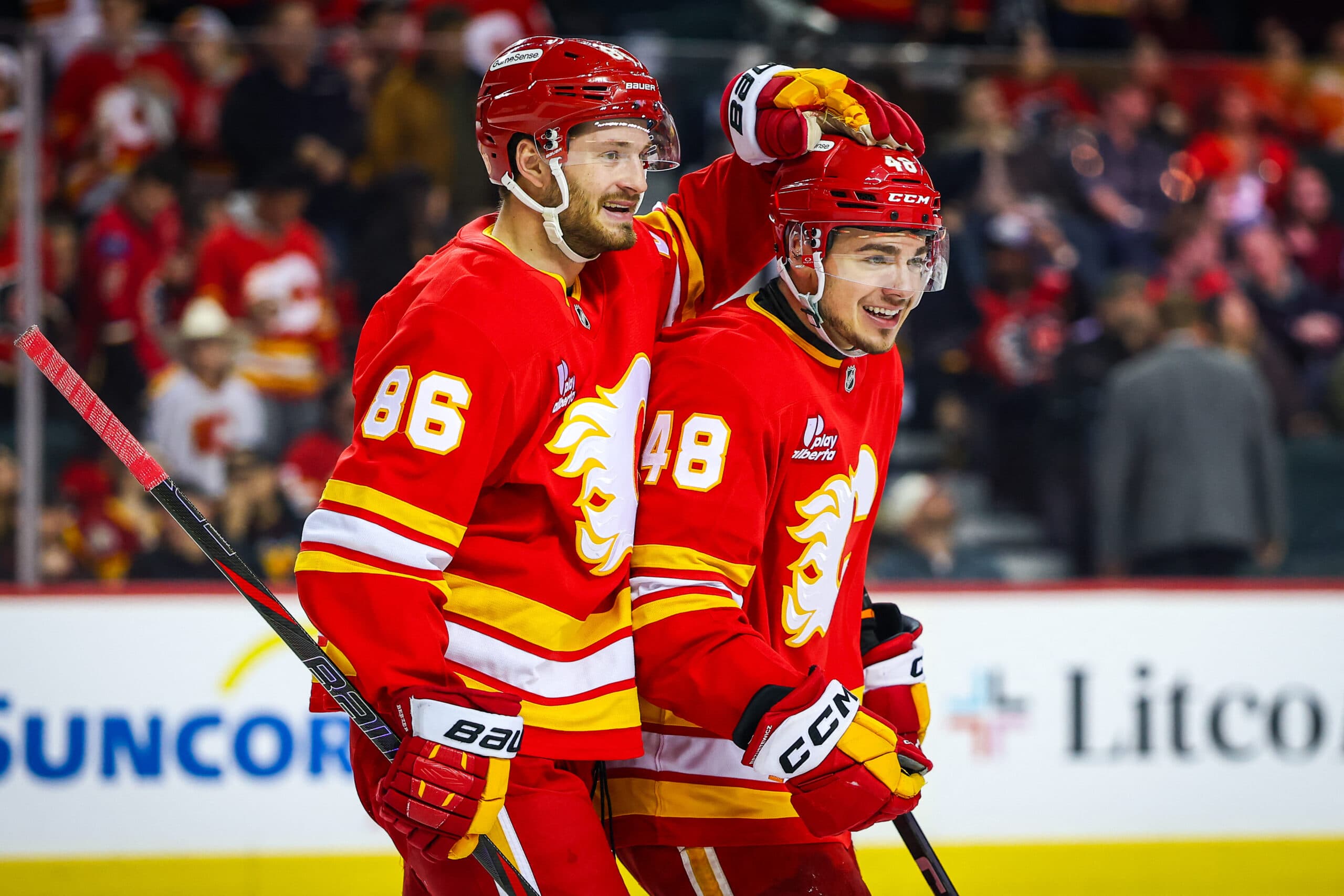
Photo credit: Sergei Belski-Imagn Images

By Mike Gould
Aug 4, 2026, 14:00 EDTUpdated: Aug 4, 2026, 14:45 EDT
Entering the 2025-26 season, Joel Farabee’s position within the Calgary Flames organization was … well, tenuous.
Acquired from the Philadelphia Flyers midway through the 2024-25 campaign, Farabee finished the year with just three goals and six points in 31 games with the Flames, totals he described as “embarrassing” in his season-ending exit interview. And with three years at a $5 million cap hit still left on his contract, the Cicero, N.Y. product risked being lost in the shuffle in Calgary without a big bounce-back year.
Well, the 2025-26 season certainly wasn’t a perfect one for the Flames, but Farabee was one of their brighter spots — as was Morgan Frost, who joined him in Calgary via that same trade with the Flyers. Farabee skated in all 82 games with the Flames in 2025-26, tying for second on the team with 20 goals and finishing alone in fifth with 38 points; Frost paced the team with 22 goals, while his 43 points tied him with Mikael Backlund for second overall in team scoring.
It was a welcome turnaround for two players who arrived in Calgary with much fanfare in January of 2025 but struggled to make an impact in the immediate aftermath of the trade. As you may recall, the Flames parted with Andrei Kuzmenko, Jakob Pelletier, a 2025 second-round pick and a 2028 seventh-round pick to land Farabee and Frost in the first place, and before last season, it looked as though they might have a hard time recouping those assets in any future deals. (It’s worth keeping in mind that the Flyers ended up flipping Kuzmenko for a third-round pick soon after the initial trade).
But now, with both ex-Flyers forwards having carved out significant roles in Calgary, one of the topics du jour around these parts pertains to their futures with the Flames — should they stick around, and if not, how much could the team get for them? Considering how well they performed in the 2025-26 season, is it fair to say that Farabee and Frost have never been worth more?
We’ll dig into that — and plenty more — in this mid off-season edition of 5 Flames Takes!
1. It’s hard to believe that we’re coming up on three years since the start of the 2023-24 season, in which the Flames had to make pivotal decisions on half a dozen pending UFAs in quick succession. (Spoiler alert: Mikael Backlund was the only one who stuck around). It was a trial by fire for Craig Conroy, then only a rookie GM, and one of his first orders of business was to figure out what to do with Elias Lindholm. Ultimately, it didn’t make much sense for the Flames to sign Lindholm to a long-term extension that would begin shortly after he turned 29, and they ended up trading him to the Vancouver Canucks. Why is this relevant? Because we’ve now reached the point where Frost is due for a new contract, and the Flames will have to weigh the pros and cons of signing or trading him. Frost will be 28 when his next deal takes effect, and he hasn’t come anywhere close to the heights Lindholm reached during his own tenure in Calgary. In theory, that could make him more affordable, but as the salary cap continues to skyrocket, very few centres are making it to free agency. As was the case when they traded Lindholm, the Flames are in a rebuild and, as such, shouldn’t be in the business of signing players deep into their 30s. And if the Flames do move Frost around the Mar. 1 trade deadline, they might be able to sign Cole Reschny to fill his spot shortly thereafter.
2. Centres are in extremely short supply, which should boost Frost’s trade value considerably. The same doesn’t exactly apply to Farabee, who is a $5 million middle-six winger with an extra year on his contract. Farabee is a year younger than Frost and has a slightly stronger track record of two-way play; he’s a three-time 20-goal scorer who can play in all situations. After trading Blake Coleman to the Minnesota Wild last month, the Flames will likely turn to Farabee to help fill the void with his leadership, defensive ability, and scoring touch. Farabee will also continue to be one of Calgary’s go-to penalty killers, potentially skating alongside one or more of Mikael Backlund, Jonathan Huberdeau, Yegor Sharangovich, and Sam Honzek on a regular basis in 4-on-5 situations. Frost may be more appealing to other teams in the trade market, but Farabee might actually be worth more to the Flames in the long run. Even if the Flames end up keeping one and trading the other, they’ll probably still end up coming out ahead from an asset-value perspective; both Frost and Farabee have to be worth more than a second and third on their own, right?
3. Speaking of major decisions, the Flames will eventually have to make one regarding their group of defencemen. As it stands, they have at least nine who they’d like to get into NHL games at the start of the 2026-27 season. The path of least resistance appears to be sending Hunter Brzustewicz to the AHL, which feels like an imperfect solution given his impressive performances with the Flames last season. But with Simon Nemec now in the fold, and Jake Middleton sliding right into the spot vacated by Olli Maatta in the Coleman trade, the Flames don’t even have any space for Joel Hanley and Brayden Pachal, much less Brzustewicz. On paper, it feels like Zach Whitecloud should be the one to go, given his strong league-wide value, looming UFA status (he’s due to hit the market in 2028), and the fact that Brzustewicz loses his waiver-exempt status in 2027-28. At the same time, Whitecloud has been such a seamless fit in the Calgary hockey community and is a much-needed veteran in a sea of unproven young defenders. He’s already contributed more off the ice in six months as a Flame than most players do in their entire NHL careers. Still, if it’s a matter of choosing between a 21-year-old in Brzustewicz or a 29-year-old in Whitecloud, it definitely feels like there’s a correct answer — even if it’s not necessarily an easy choice. Perhaps it would make sense for the Flames to flip Whitecloud for a small fortune at the 2027 trade deadline before potentially circling back on him as a free agent in 2028, particularly if Brzustewicz struggles to handle more difficult assignments in his absence.
4. This has been a very strange summer for NHL contracts, with teams finally free to spend as they please after toiling for years under the burden of the flat salary cap. One of our new refrains here at FlamesNation is that “there are no bad contracts, only bad fits.” $5 million gets you a far different player today than it did two years ago, and it’ll get you even less two years into the future. What does that mean for the likes of Huberdeau and Sharangovich, whose current deals run for at least the next four years at sub-optimal rates? It means that the Flames probably shouldn’t rush to part with either player for the sake of it, and they certainly shouldn’t pay to move either contract off their books. In all likelihood, we’ve already seen multiple teams hand out contracts this summer that will age poorly over the coming seasons, and there should eventually be opportunities for Conroy to take advantage of other GMs desperate to shed their own problematic deals. One of the biggest mistakes Conroy’s predecessor made was giving up a future first-rounder to shed the final year of Sean Monahan’s contract. With that error in mind, the smartest thing the Flames can do is to give Huberdeau and Sharangovich every opportunity to play their way out of the red. The closer both players get to the end of their deals, the easier they’ll be to trade. In the end, the Flames might have to take some money back, but they could still extract positive value for both players.

Jonathan Huberdeau puts Calgary on the board 🚨 📺: Flames 🆚 Flyers live on Sportsnet
5. Much has been made about the Flames’ most obvious trade candidates: Frost, Whitecloud, Ryan Strome, and the like. But there are a few others who could be moved before long to make room for an influx of new young talent. One such name is Adam Klapka, who has one year remaining on his current deal and can become an RFA with arbitration rights in 2027. Klapka is a fine player, but he’ll be 26 when the Flames hit the ice next season, and it certainly isn’t difficult to imagine a more competitive team becoming infatuated with his mixture of size and skill and paying handsomely to add him into the fold. He’d make a great deadline add, and with so many young players slated to make the jump to the NHL when Scotia Place opens, the Flames won’t need to have both Klapka and Martin Pospisil taking up spots beyond 2026-27. Teams with genuine championship aspirations tend to be desperate to add size whenever they can get it; just look at Michael McCarron, who went from Nashville to Minnesota last season for a second-round pick. If the Flames can fetch that kind of return for Klapka, whom they signed as an undrafted free agent four years ago, they’d be nuts not to take it — especially if it means opening up a bottom-six spot for, say, Aydar Suniev or Jonathan Castagna.
Sponsored by bet365:


Breaking News
- Flames Game Day 10: A visit from the Red Wings (8pm MT, SNW)
- The Flames’ 2004 green hard hat returns as a fan giveaway on Saturday
- Series Preview: Wranglers wrap up road trip in second series against Canucks
- Notes from last game: Devin Cooley plays out of his mind again in Flames’ 2-1 victory over Wild
- Ranking the Flames’ dark jerseys: From the classic reds to the pedestals and Blasty

Calgary FlamesTeam Cap Summary

Cap Summary
2026-27
2027-28
Projected Cap Hit
$90,440,132
$69,841,666
Projected Cap Space
$13,559,868
$43,658,334
Current Cap Space
$15,474,202
$43,658,334
Active Players
23/23
16/23
Draft Picks
Round
'27
'28
1
1
1
2
2
2
3
2
1