
FlamesNation has no direct affiliation to the Calgary Flames, Calgary Sports and Entertainment, NHL, or NHLPA
Dustin Wolf’s rough start to the season is nothing new for second-year netminders
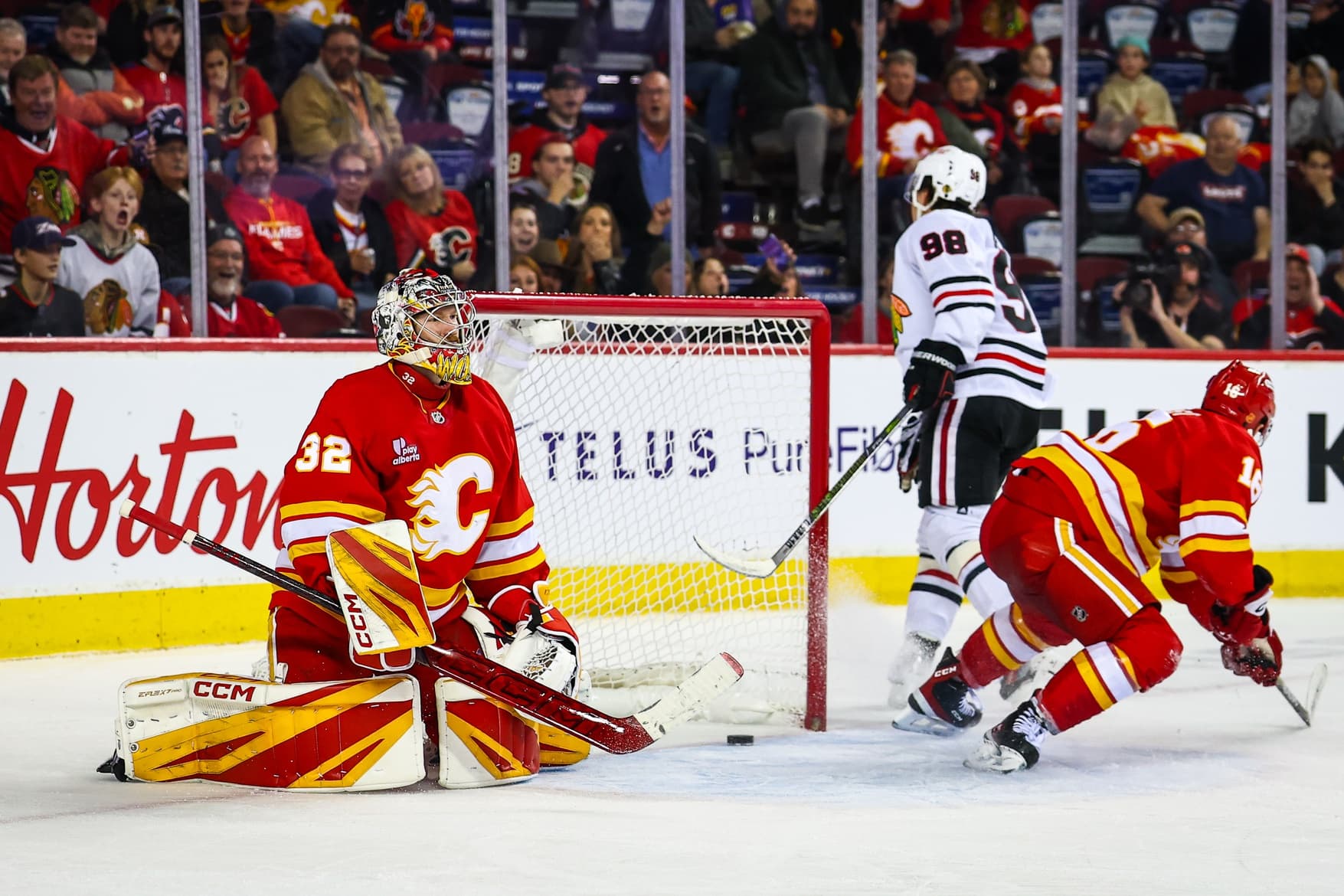
Photo credit: Sergei Belski-Imagn Images

Nov 29, 2025, 12:00 ESTUpdated: Nov 29, 2025, 00:41 EST


There tends to be a prevailing theme amongst goalies that are become finalists for the Calder Trophy.
Historic figures show that seventh-round picks tend not to make the National Hockey League, but Dustin Wolf is a rare exception. Drafted 214th overall in the 2019 draft, Wolf made 18 starts between 2022-23 and 2023-24, before entering the 2024-25 season as a rookie.
It was a terrific season for the then 23-year-old, posting a .910 save percentage and 2.64 goals against average in 53 games, compiling a 29-16-8 record. Wolf is the biggest reason the Flames nearly made the playoffs, finishing with 96 points, but losing on a tiebreaker. Wolf’s 11.9 Goals Saved Above Expected (GSAx) of 11.9 ranked 21st among netminders with 20 or more games played.
Unfortunately, Wolf has hit the daunted sophomore slump. Through 20 games this season, the 24-year-old has an .890 save percentage and 3.17 goals against average, with a 6-12-2 record a -6.3 GSAx. Wolf has played the most games of any netminder, but is tied for the lowest GSAx for any player with 10 or more games played.
The sophomore slump is universal in all sports. A recent example of a skater came in 2022-23, as Matty Beniers won the Calder Trophy by scoring 24 goals and 57 points, but he’s yet to reach those heights again.
For some reason, it seems to impact netminders who finished as finalists for the Calder Trophy in their rookie season; Wolf is no different in this regard. Since the turn of the millennium, only Evgeni Nabokov bucks the trend, as he posted a .915 save percentage in 2000-01, winning the trophy. The following season, he had a .918 save percentage and 2.29 goals against average in 67 games.
But again, he’s the exception. North of Calgary are the Edmonton Oilers, and Stuart Skinner posted a .913 save percentage and 2.75 goals against in 2022-23, earning an All-Star Game appearance. That season, Skinner finished second in Calder Trophy voting, but hasn’t found nearly the same success.
The 2023-24 season started rough for the hometown netminder, but he finished with a .905 save percentage and 2.62 goals against average in 59 games. He dipped below .900 in 2024-25, posting an .896 save percentage and 2.81 goals against average. This year has been abysmal for the 27-year-old, which goes far beyond a sophomore slump.
A netminder rumoured to be replacing Skinner as the Oilers’ starting netminder is Jordan Binnington. The St. Louis Blues were last in the NHL early in 2019, but stormed to a playoff spot and won it all. Binnington’s success is a big reason for that, posting a 24-5-1 record with a .927 save percentage and 1.89 goals against average. Binnington finished second in Calder Trophy voting, as well as 10th in Hart Trophy and 5th in Vezina Trophy voting.
His numbers dropped off in his sophomore season, albeit he still earned Vezina Trophy votes thanks to a .912 save percentage and 2.56 goals against average. It was a slow decline from there with a rebound season in 2025-26, but it was still a sophomore slump of sorts.
In 2020-21, Alex Nedeljkovic finished third in Calder Trophy voting thanks to a .932 save percentage and 1.90 goals against average in 23 games with the Carolina Hurricanes. That off-season, he was traded to the Detroit Red Wings and had a strong start to the year.
Unfortunately, the second half of the season was a disaster, and Nedeljkovic finished with a .901 save percentage. Since those 23 games that earned him Calder Trophy consideration, Nedeljkovic has an .899 save percentage and 3.19 goals against average in 160 games played.
These three netminders were the last three that were finalists for the Calder (prior to Wolf). There was a long stretch that didn’t see a netminder be a finalist in the last nine seasons. Before Binnington, it was Jimmy Howard who was a finalist in 2009-10.
Howard had a cup of tea with the powerhouse Detroit Red Wings in the mid-aughts, but didn’t become the team’s starter until 2009-10. That season, he played 63 games and finished with a .924 save percentage and 2.26 goals against average, along with a 37-15-10 record. The only rookie better than him that season was Tyler Myers, as the defenceman took home the Calder Trophy.
His next season was still solid, finishing with a .908 save percentage and 2.79 goals against average in 63 games, but it was a step drop off. Howard eventually returned to form the following six seasons, before turning into a .910 save percentage goaltender for the rest of his career.
Steve Mason was the last netminder to win the Calder Trophy, and like Howard, he burst onto the scene in a big way. In 2008-09, he finished with a .916 save percentage and 2.29 goals against average in 61 games, posting a 33-20-7 record. Not only did Mason win the Calder trophy, but he also finished as the runner-up in Vezina Trophy voting and finished fourth in Hart Trophy voting.
The right-handed goaltender propelled the Columbus Blue Jackets into the post-season for the first time in franchise history (they were swept by the Detroit Red Wings). Mason’s play declined the following season, finishing the year with a .901 save percentage and 3.05 goals against average. Granted, the Blue Jackets weren’t a good team, much like the Flames this season.
Mason went on to have a 10-year NHL career, finishing with a .911 save percentage and 2.70 goals against average. Aside from serving as the backup netminder of the Blue Jackets and Philadelphia Flyers in 2012-13, Mason was a career starter until his final season in 2017-18. He also received Vezina votes in 2013-14.
Before Mason won the Calder Trophy, but after Nabokov won it was Andrew Raycroft. Like many netminders, he had a cup of tea in the National Hockey League before his rookie season. He became the Boston Bruins’ starter in 2003-04, posting a .926 save percentage and 2.05 goals against average, finishing fifth in Vezina Trophy voting and 13th in Hart Trophy voting.
After another season with the Bruins, Raycroft was traded to the Toronto Maple Leafs for Tuukka Rask, and his career fizzled out from there.
The thing is, the sophomore slump happens to the best of netminders. Carey Price is widely considered the best netminder of his generation, and after posting a .920 save percentage in his rookie season, his save percentage dropped to .905. Connor Hellebuyck’s save percentage went from .918 in his rookie season to .907. Martin Brodeur went from a .9815 save percentage to a .902 save percentage. Ed Belfour went from a .910 save percentage to an .894 save percentage. The last two won their respective Calders, and trust me, the list goes on.
What’s happening to Wolf is nothing new; even all-time greats have suffered a sophomore slump. In the end, he’ll be okay.
Ryley Delaney is a Nation Network writer for FlamesNation, Oilersnation, and Blue Jays Nation. She can be followed on Twitter @Ryley__Delaney.
This article is brought to you by Crystal Waters

Call Crystal Waters Plumbing and Heating today at 403-219-4100 for a complete mechanical system audit, and learn how we can partner with you to ensure your home is optimized for safety, health, and comfort. Or check them out at www.crystalclearcalgary.com


Breaking News
- Scenes from Flames practice: A couple new lines and pairings, and new goalie gear for Dustin Wolf
- Should Darryl Sutter be in the Hockey Hall of Fame?
- Recap: Ben Jones had another two goal game but Wranglers fall by one in San Jose
- Flashback Friday: Looking at the fallout from the Flames’ most recent trade with the Hurricanes
- Theo Stockselius and Flames’ college kids shined this past week

Calgary FlamesTeam Cap Summary
Cap Summary
2026-27
2027-28
Projected Cap Hit
$89,682,143
$69,841,666
Projected Cap Space
$14,317,857
$43,658,334
Current Cap Space
$15,693,018
$43,658,334
Active Players
23/23
16/23
Draft Picks
Round
'27
'28
1
1
1
2
2
2
3
2
1