
FlamesNation has no direct affiliation to the Calgary Flames, Calgary Sports and Entertainment, NHL, or NHLPA
Flames’ power play remains a work in progress heading into new season
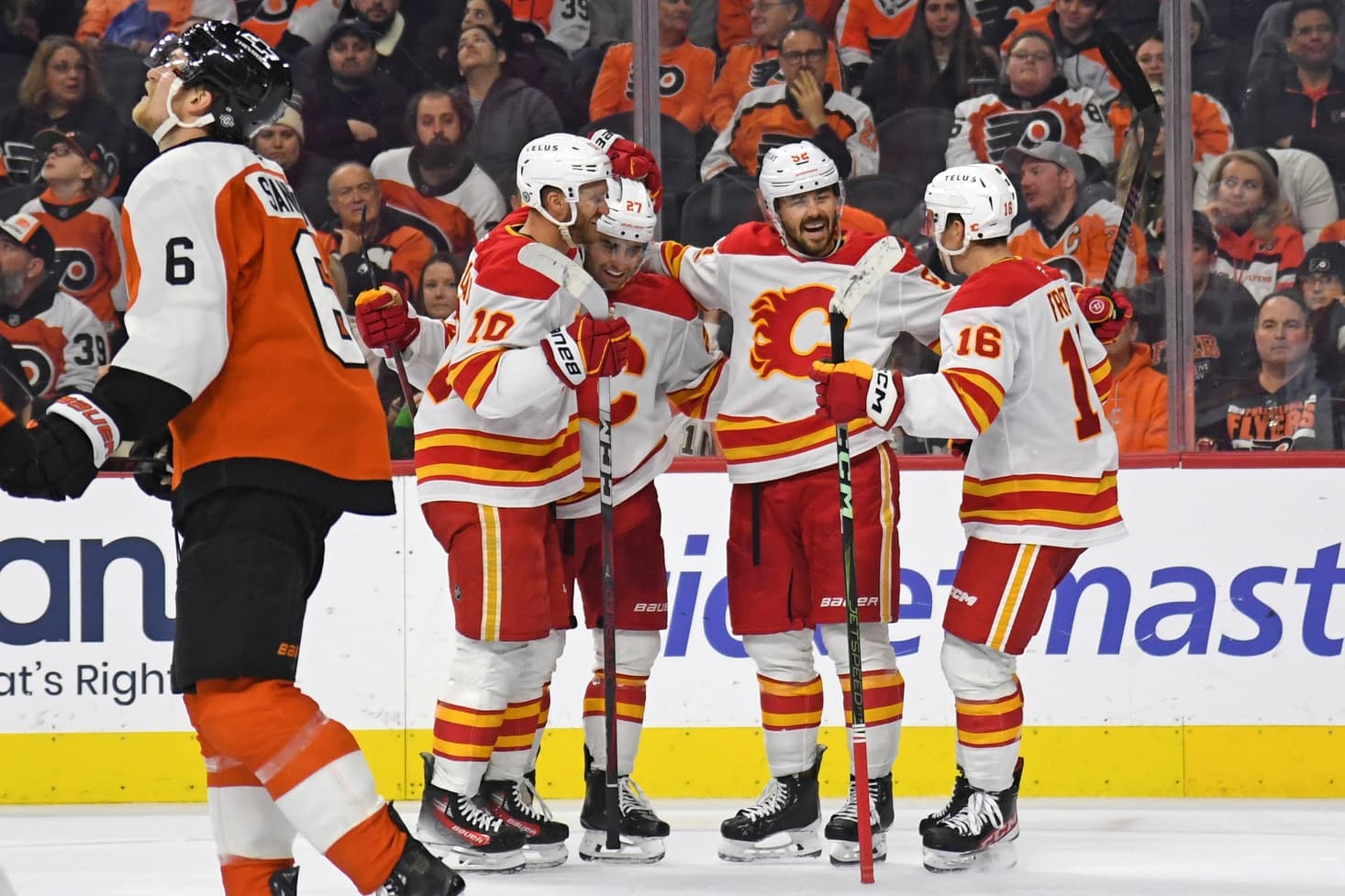
Photo credit: Eric Hartline-Imagn Images

By Adrian Kiss
Sep 17, 2025, 14:00 EDTUpdated: Sep 17, 2025, 11:53 EDT


Last season was filled with exciting storylines, with the Calgary Flames narrowly missing the playoffs in a year when they were expected to be well out of the race.
One storyline that was anything but exciting — and arguably played a major role in Calgary missing the post-season — was their special-teams play, particularly on the power play.
The Flames officially ranked 19th overall with a power play percentage of 21 per cent. In the time span between the 4-Nations Face-off and the end of the season, they ranked 25th. Not ideal if you’re in the midst of a playoff race.
While there were flashes of strong play, the power play rarely generated enough pressure or finish to be considered a real threat.
What went wrong?
Let’s start with who manned the power play. Although there were plenty of changes throughout the season, the Flames closed out the year deploying these units:
PP1
Huberdeau–Frost–Kadri
Coronato–Weegar
Huberdeau–Frost–Kadri
Coronato–Weegar
PP2
Coleman–Backlund–Zary
Andersson–Sharangovich
Coleman–Backlund–Zary
Andersson–Sharangovich
Let’s be honest: it took far too long for Matthew Coronato to earn a spot on the top unit — he should have been there all year. Meanwhile, with Mikael Backlund and Yegor Sharangovich struggling offensively, they didn’t have much business being on the power play. Though who else would have fit in there?
The bigger issue, though, lies in the numbers. According to NHL Edge, the Flames spent just 56.7 per cent of their power play time in the offensive zone, below the league average of 58.1. On the flip side, they spent 28.5 per cent of their man-advantage time in the defensive zone, above the league average of 27.8.
For comparison, the Vegas Golden Knights — one of the league’s top power plays — spent 62.1 per cent of their time in the offensive zone and only 24.8 in the defensive zone.
The Flames simply didn’t spend enough time attacking to generate consistent offence. And without superstar finishers, they lacked the firepower to capitalize. Jonathan Huberdeau, Nazem Kadri, Coronato and MacKenzie Weegar were the only Flames to record double-digit power-play points. Huberdeau led with 23, which tied him for just 50th in the league.
Much of the Flames’ play was kept to the perimeter. They didn’t appear to have many effective set plays, with cross-ice passes often failing and possession being lost. With little support in the high slot or net-front presence, scoring chances were limited. Add in the absence of a bona fide top centre, and face-off losses frequently forced them to chase the puck back down the ice instead of setting up in the offensive zone.
How can the Flames fix this?
It won’t be an easy or immediate fix. Other than draft picks, Calgary hasn’t added to its forward group, and those prospects aren’t expected to be NHL-ready this season. That means the team will likely roll out similar units to last year.
For the power play to improve, young forwards like Morgan Frost and Connor Zary need to take another step. The first-unit centre spot is likely up for grabs. If one of them — or another player — can consistently win draws and contribute offensively, that role could be theirs. Veterans such as Huberdeau and Kadri will still be leaned on heavily, and perhaps Adam Klapka, tested briefly as a net-front presence last year, could provide a solution.
The biggest potential difference-maker could be on the blue line. If Zayne Parekh makes the team — and he should — he could change the dynamic of the power play on his own. He’ll likely start on the second unit to ease into NHL play, but given his track record, it may not be long before he’s quarterbacking the top unit. Parekh finished second in the OHL in power-play points last season with 46. His skating and offensive instincts could open up a wide range of new opportunities, much like what Quinn Hughes provides in Vancouver or Cale Makar in Colorado.
It will be interesting to see what the Flames unveil in training camp and the pre-season. With an essentially new coaching staff — Trent Cull officially added as an assistant after serving as interim last year, and Dave Lowry brought in as another assistant — new philosophies and strategies may help spark improvement.
The power play should provide momentum and production. Instead, last season the man-advantage was basically a disadvantage. It’s hard to envision the Flames taking major strides if they run back the same units, but there is reason for optimism. A new quarterback is waiting in the wings, and a new philosophy could be on the way.
In an ideal scenario, the Flames’ power-play units to start the season should look like this:
PP1
Huberdeau–Frost–Kadri
Coronato–Parekh
Huberdeau–Frost–Kadri
Coronato–Parekh
PP2
Klapka–Backlund–Zary
Farabee–Weegar
Klapka–Backlund–Zary
Farabee–Weegar
How do you see the Flames’ power play shaping up heading into the new season? Do you think they have any chance to be formidable?
Sponsored by bet365:


Breaking News
- Wranglers forward Ben Jones just might be the Flames’ first man up
- Hunter Brzustewicz reflects on off-season, pre-season and the road ahead with the Wranglers
- Monday Mailbag: Talking early season results, attendance and more!
- Beyond the Boxscore: Flames survive Hurricanes relentless forecheck to win game 3-2
- Three crucial minutes for Flames led to big victory over Carolina

Calgary FlamesTeam Cap Summary

Cap Summary
2026-27
2027-28
Projected Cap Hit
$89,682,143
$69,841,666
Projected Cap Space
$14,317,857
$43,658,334
Current Cap Space
$15,872,367
$43,658,334
Active Players
23/23
16/23
Draft Picks
Round
'27
'28
1
1
1
2
2
2
3
2
1