This article is brought to you by bet365.
Folks, over the last little while we’ve been delving into the drafting history of the Calgary Flames. (And that look-back will continue as we approach the 2024 NHL Draft at the end of the month.)
But as we delve, we’ve wondered what success looks like at this upcoming draft and it led us to a simple question: how successful have they been in past NHL Drafts?
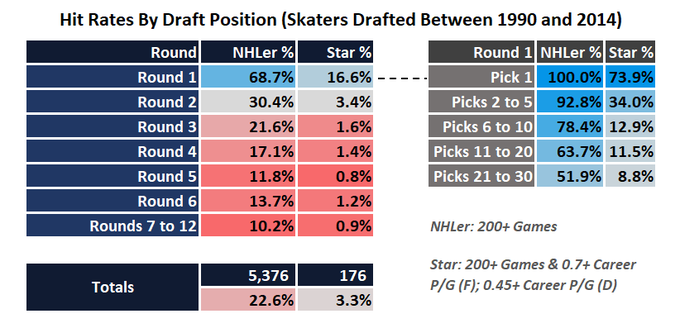
We dug into the numbers to figure it out, exploring two specific but related concepts: finding NHLers and finding star NHLers.
Finding stars
If you’re into drafting and development, we highly recommend following Byron Bader on whatever Twitter’s called nowadays. (Cheap plug: Bader’s a FlamesNation alum!)
In his discussions about drafting and development, Bader has teased out a specific goal of drafting: finding stars.
By Bader’s estimation, a star is a player that plays 200-plus NHL games and maintains production of 0.7 points-per-game for forwards or 0.45 points-per-game for defencemen. If we look at the period Bader’s post examines (1990-2014), the Flames selected the following players that would be considered stars by this definition:
- D Robert Svehla – 1992 fourth-round pick
- F Cory Stillman – 1992 first-round pick
- D Dion Phaneuf – 2003 first-round pick
- F Johnny Gaudreau – 2011 fourth-round pick
- F Sean Monahan – 2013 first-round pick
If you break it down by round:
Round | Stars | Picks | Star % | Expected Stars |
1 | 3 | 26 | 11.5% | 4.3 (16.6%) |
2 | 0 | 27 | 0.0% | 0.9 (3.4%) |
3 | 0 | 28 | 0.0% | 0.4 (1.6%) |
4 | 2 | 32 | 6.3% | 0.4 (1.4%) |
5 | 0 | 28 | 0.0% | 0.2 (0.8%) |
6 | 0 | 23 | 0.0% | 0.3 (1.2%) |
7-12 | 0 | 63 | 0.0% | 0.6 (0.9%) |
All | 5 | 227 | 2.2% | 7.5 (3.3%) |
Based on the math, the Flames hit on star players below the expected rate during this period.
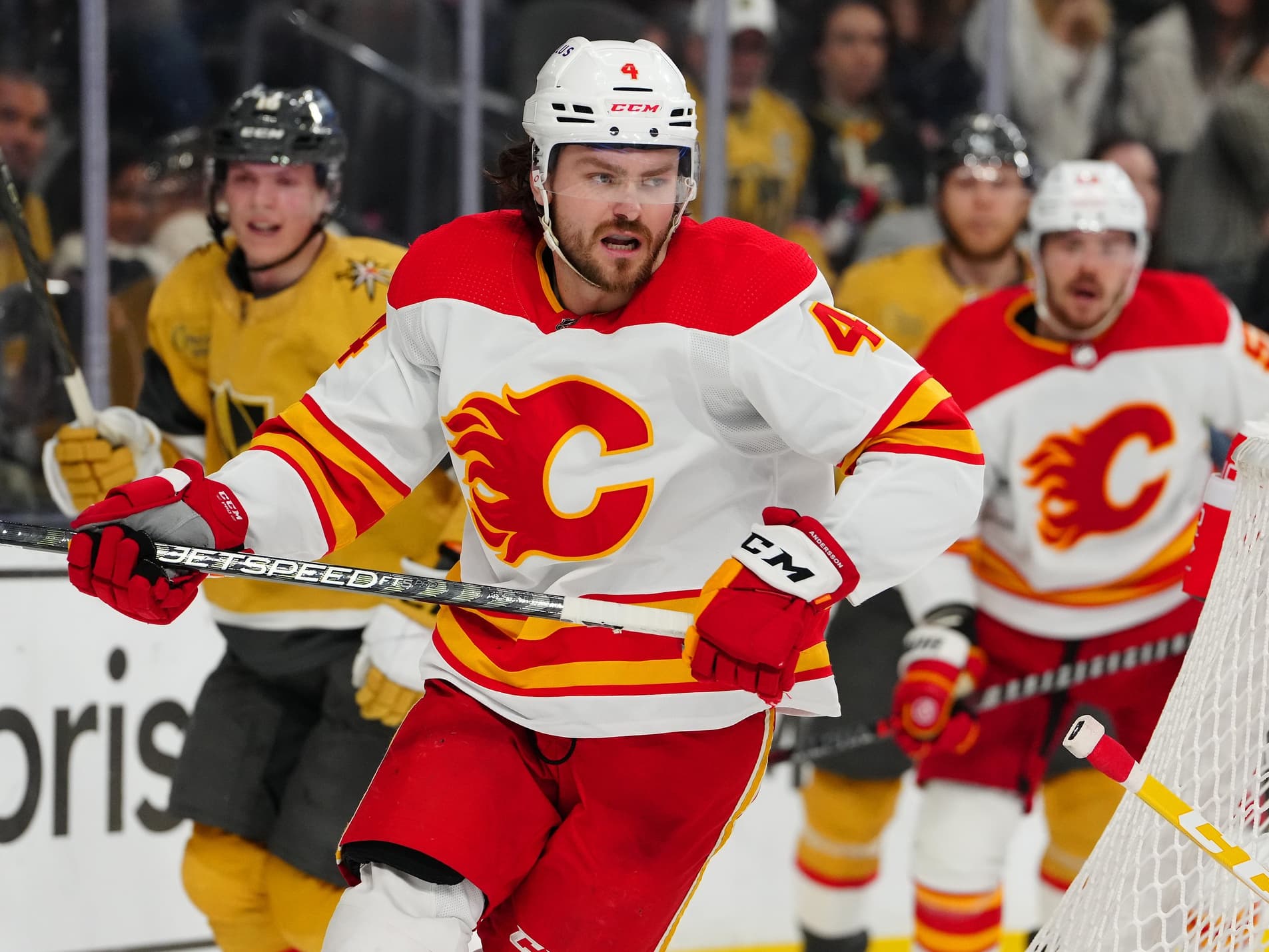
To expand the lens of analysis a little bit further, both Adam Fox and Matthew Tkachuk are considered stars from the 2016 Flames class, while Rasmus Andersson falls five points below the points-per-game threshold to be considered one. If you look at the 19 picks the Flames made in the 2015-17 drafts, the Flames would have been expected to produce 0.6 stars (irrespective of the rounds they selected in).
Finding NHLers
We’ll acknowledge that finding stars is tough. A lot of things have to break the right way after a player is drafted for them to develop into a star. But what about just finding NHL bodies? The threshold is much lower – players that play 200-plus NHL games meet this requirement – and, not surprisingly, the Flames have been way more productive by this metric.
Let’s break it down by round, again:
Round | NHLers | Picks | NHLer % | Expected NHLers |
1 | 15 | 26 | 57.6% | 17.9 (68.7%) |
2 | 6 | 27 | 22.2% | 8.2 (30.4%) |
3 | 7 | 28 | 25.0% | 6.0 (21.6%) |
4 | 7 | 32 | 21.9% | 5.5 (17.1%) |
5 | 3 | 28 | 10.7% | 3.3 (11.8%) |
6 | 5 | 23 | 21.7% | 3.2 (13.7%) |
7-12 | 5 | 63 | 7.9% | 6.4 (10.2%) |
All | 48 | 227 | 21.1% | 51.3 (22.6%) |
The rounds where the Flames produce NHLers at a higher rate than expected are the third, fourth and sixth. They under-perform the data everywhere else. On the aggregate, they produced 3.3 fewer 200-game NHL players during this time period than league-wide hit rates suggest they should have.
Again, to expand the lens of analysis a bit more, the Flames drafted seven players after 2014 that surpassed 200 NHL games: Andersson (2015), Oliver Kylington (2015), Andrew Mangiapane (2015), Tkachuk (2016), Dillon Dube (2016), Fox (2016) and Juuso Valimaki (2017). If you look at the 19 picks the Flames made in the 2015-17 drafts, the Flames would have been expected to produce 4.2 NHLers (irrespective of the rounds they selected in).
Conclusions and trends
If you look at the Flames’ drafting history and go “Oh man, they haven’t found a lot of aces…” well, yeah. That’s what the data bears out. They’ve had a tough time finding stars, though they’re doing a little better if you expand the analysis up to 2017. (But since 2017, they haven’t found any stars.)
If you look at the Flames’ drafting history and observe they they do an adequate job finding NHL players, that seems to be the case, and when you expand the window of analysis into 2017 they’ve done a pretty solid job overall.
But with the Flames likely aiming to jump-start their retooling process, they’ll likely need to exceed their historical performances in order to have a strong draft.