
FlamesNation has no direct affiliation to the Calgary Flames, Calgary Sports and Entertainment, NHL, or NHLPA
Why video coach Jamie Pringle may be the Flames’ secret weapon
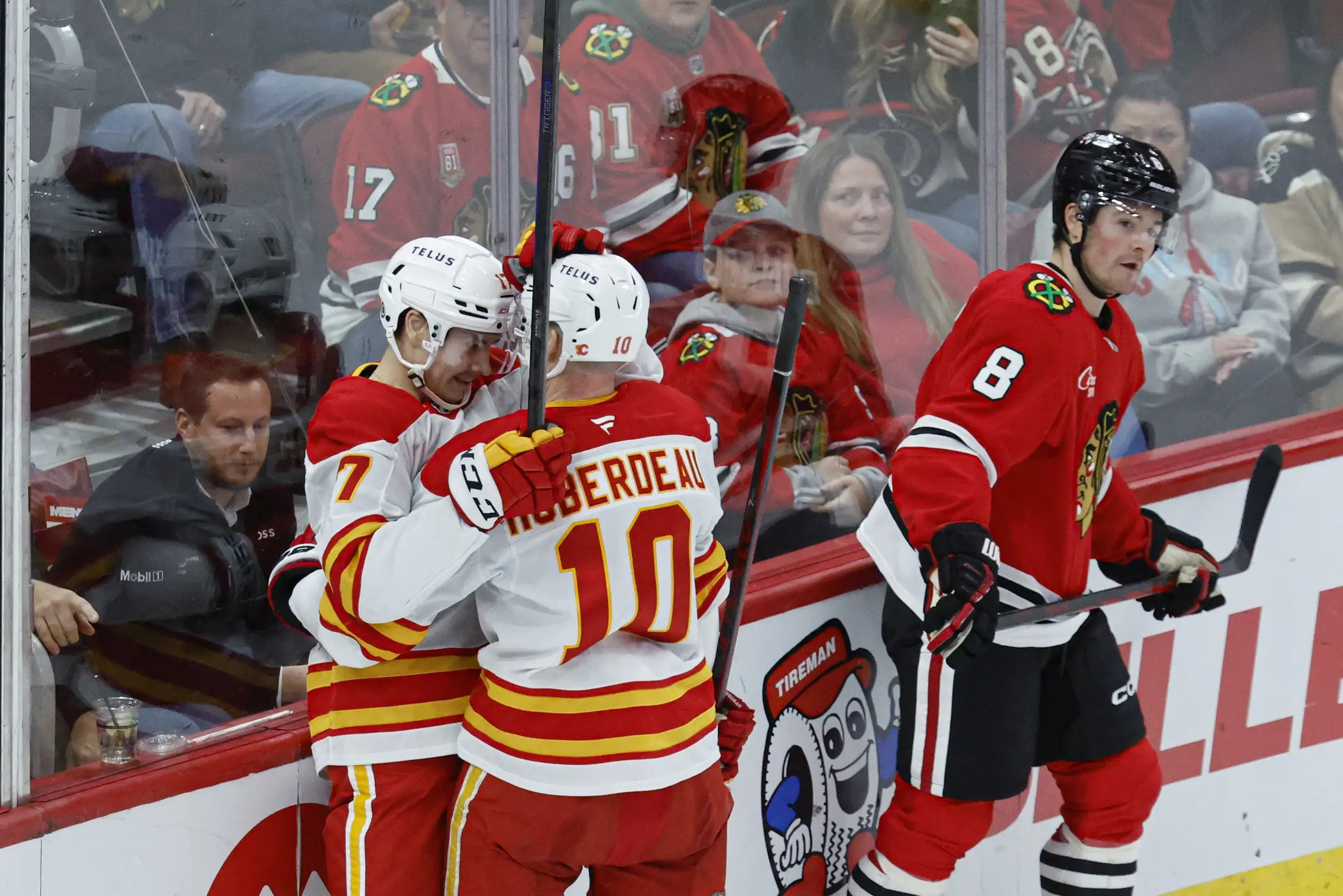
Photo credit: Kamil Krzaczynski-Imagn Images


If there’s one thing that unites hockey fans and members of the media, it’s a general sense of bewilderment and confusion – and perhaps even frustration – regarding coach’s challenges.
In-arena, coach’s challenges cause the flow of the game to screech to a halt, and often it feels like a coin toss regarding which way the challenge will go (and for what stated reasons). But when it comes to the Calgary Flames, they don’t seem to have nearly the level of apprehension regarding challenges, and they’ve made a lot of challenges in 2024-25 and had a lot of success doing so.
With 27 games left on the Flames’ regular season schedule, let’s discuss coach’s challenges… and why video coach Jamie Pringle may be their secret weapon.
Let’s dive into the rules
Coach’s challenges are regulated by Rule 38 of the NHL rulebook.
In regards to goals, only three situations fall under coach’s challenges:
- Off-Side: A play resulting in a goal on the ice where the defending team claims that the play preceding the goal was off-side.
- Missed Stoppage: A play resulting in a goal on the ice where the defending team claims that the play should’ve been whistled down prior to the goal.
- Goaltender Interference: Either a play called a goal on the ice where the defending team felt their goaltender was interfered with, or a play called no-goal on the ice due to goaltender interference where the attacking team felt that there wasn’t goaltender interference on the play.
(There have been rare instances of multiple coach’s challenges on the same sequence, where a play called no-goal on the ice was challenged and changed to a goal after a goaltender interference review, and then challenged for being off-side.)
If a coach’s challenge is successful, the call on the ice is reversed – usually from goal to no-goal. If you’re unsuccessful, the goal stands and your side gets a delay-of-game minor penalty. In the final minute of third period and all of overtime, anything that would’ve been subject to a coach’s challenge is automatically reviewed by the Situation Room in Toronto, so no challenges are needed and an unsuccessful challenge doesn’t result in a penalty.
How things play out
When you watch a Flames game on Sportsnet – or any NHL game on any channel – you’ll see the same thing after every single goal; they cut to the bench to get their reaction to a goal against, only to get a shot of every single coach staring at their feet. Only they’re not staring at their feet: every NHL bench, home and away, has a monitor built into the floor, and each team’s video coach will be feeding clips to their bench during the game.
So when a goal is scored against the Flames, or anyone else, the very first thing that they check out – via the clips from their video coach – is whether or not there’s anything that should be challenged on the play. Most goals in the NHL are pretty straightforward, and among the thousands of goals scored every year, typically a fraction are worth a challenge.
But the decision to challenge or not has to be made pretty quickly. Under the NHL rulebook, coaches have until the following face-off to challenge a goal; they must signal by “verbally communicating to a referee” before puck drop that they’re challenging. With the video coach – Pringle for the Flames – sorting through all of the available replays for an angle that could provide proof of an infraction (or lack thereof), it can be a bit of a frenzy following some goals.
“You’ll see the computer moving a little bit back and forth while he’s trying to look at different views,” said Huska after a Flames practice last week. “And as things come in from the truck, that’s what takes a little bit of time sometimes. So if there is one that you’re in question on, you’re always waiting for another view to see if there’s something that’s conclusive. So when coaches stall, that’s usually what they’re doing is they’re hoping that there’s going to be something coming from one of the trucks that will give us a better picture. That will allow the decision to be an easier one to be made.”
Under Rule 38, “teams may not unduly delay the resumption of play while evaluating whether or not to initiate a Coach’s Challenge.” So while coaches will try to stall to maximize the value of their replay window, they can’t stall too much or else they could incur a delay-of-game bench minor. We looked and we couldn’t find a recent instance of a coach getting a delay-of-game in that situation, though, as referees tend to warn the bench and then go “Okay, we’re dropping the puck!” rather than give out penalties.
The secret to the Flames’ success
Special teams have proven crucial to success in the NHL, to the point where every club has an assistant coach specializing in those areas – sometimes multiple. Video coaches have been a part of NHL staffs for awhile, but the introduction of the coach’s challenge in 2015-16 added a new layer of complexity to that role.
Pringle has been the Flames’ video coach since 2011-12, and he’s developed some expertise in the coach’s challenge, as reflected by this season’s success.
“I think the biggest thing for us is Jamie does his homework,” said Huska. “I think he has a good understanding of what the league is calling and what they’re not calling. And because he’s prepared, I feel comfortable with his suggestions and with his thoughts. And when he flashes something on the screen for me, I know the detail and the preparation has been put into it. So I trust him a lot.”
Coach’s challenges at a glance (league-wide, by challenge type)
Challenge Type | Challenges | Overturned | Success Rate |
Goalie Interference | 85 | 51 | 60.0% |
— No-Goal Challenged | 12 | 3 | 25.0% |
— Goal Challenged | 73 | 48 | 65.8% |
Off-Side | 68 | 61 | 89.7% |
Missed Stoppage | 10 | 4 | 40.0% |
The Flames have made nine challenges in 2024-25: five for goalie interference and four for off-side. They’re perfect on off-side challenges and have one failed challenge for goalie interference – their lone unsuccessful challenge was Nov. 25 against Ottawa.
Only San Jose has more coach’s challenges (10) this season. Nobody has more successful challenges than the Flames (8). The league’s average success rate on challenges is 71%, Flames are at 89%. Six teams remain perfect (Anaheim, Dallas, Minnesota, Montreal, Toronto and Vegas), but all have made fewer challenges than the Flames.
The Flames are a team that has to play in a lot of close games. They’ll likely either make or miss the playoffs by a very thin margin. Much like the club’s special teams units, and arguably less appreciated, Pringle’s work on coach’s challenges could prove to be the factor that nudges them over the cutline when the season ends on Apr. 17.
Sponsored by bet365:


Breaking News
- Darryl Sutter reflects on his career, his son becoming a coach, and The Code of The West
- Beyond the Boxscore: Flames give start to finish quality performance in first victory of season
- Series preview: Wranglers kick off six game road trip with stop in San Jose
- Instant Reaction: Flames finally get two points after rematch with the Ducks
- NHL Notebook: Penguins and Sabres make small trade

Calgary FlamesTeam Cap Summary

Cap Summary
2026-27
2027-28
Projected Cap Hit
$89,682,143
$69,841,666
Projected Cap Space
$14,317,857
$43,658,334
Current Cap Space
$15,431,468
$43,658,334
Active Players
23/23
16/23
Draft Picks
Round
'27
'28
1
1
1
2
2
2
3
2
1